“That men do not learn very much from the lessons of history is the most important of all the lessons of history.”
Get your Free
financial review
Why did the Roman Empire fall ? Historians continue to argue about the reasons for its collapse – a debate attaining added piquancy today given that western civilisation and culture appears to be following Rome over the cliff’s edge. Of the factors often cited for the fall of Rome, some seem to have uncanny echoes here in 2026, including:
- The loss of traditional values and a widespread moral malaise;
- Unchecked invasions by foreign peoples (this time round facilitated, rather than resisted, by politicians);
- Widespread corruption and political in-fighting;
- Unsustainable foreign expansion and military over-reach;
- Economic weakness, vast indebtedness and uncontrolled currency inflation.
As professional investors we might be expected to have a particular wariness for these last end-of-cycle characteristics. What would be wholly unique to our modern experience of crisis would be that it was deliberately triggered by the delusional beliefs of a warped doomsday cult – one that believed in anthropogenic climate change, the pursuit of ‘Net Zero’, and an unchallenged commitment to Diversity, Equity and Inclusion at the expense of any adherence to simple meritocracy.
Perhaps the defining characteristic of our current crisis is the raft of problems triggered by distant, unaccountable elitism. Catherine Liu (‘The Virtue Hoarders’):
“For as long as most of us can remember, the professional managerial class (PMC) has been fighting a class war, not against capitalists or capitalism, but against the working classes. Members of the PMC have memories of a time when they were more progressive—during the Progressive Era, specifically. They once supported working-class militancy in its epic struggles against robber barons and capitalists like Leland Stanford Jr., Andrew Carnegie, John D. Rockefeller, and Andrew Mellon, but today, they go to Stanford and view private foundations bearing those same names as models of philanthropy and sources of critical funding and recognition.
“They still believe themselves to be the heroes of history, fighting to defend innocent victims against their evil victimizers, but the working class is not a group they find worth saving, because by PMC standards, they do not behave properly: they are either disengaged politically or too angry to be civil. Liberal members of the credentialed classes love to use the word empower when they talk about “people,” but the use of that verb objectifies the recipients of their help while implying that the people have no access to power without them.
“The PMC as a proxy for today’s ruling class is shameless about hoarding all forms of secularized virtue: whenever it addresses a political and economic crisis produced by capitalism itself, the PMC reworks political struggles for policy change and redistribution into individual passion plays, focusing its efforts on individual acts of “giving back” or reified forms of self-transformation. It finds in its particular tastes and cultural proclivities the justification for its unshakable sense of superiority to ordinary working-class people.
“If its politics amount to little more than virtue signalling, it loves nothing more than moral panics to incite its members to ever more pointless forms of pseudo-politics and hypervigilance. The much-maligned Hillary Clinton was honest in her contempt for ordinary people when, in 2016, she dismissed Trump supporters as “deplorables.” Their 2016 defiance of PMC and liberal nostra has only hardened into reactionary antiauthoritarianism, which another reactionary demagogue will seek to exploit.
“PMC virtue hoarding is the insult added to injury when white-collar managers, having downsized their blue-collar workforce, then disparage them for their bad taste in literature, bad diets, unstable families, and deplorable child-rearing habits. When the PMC sympathized with the plight of masses of working people, it also pioneered professional standards of research grounded in professional organizations like the American Medical Association, the Association of University Professors, and all the professional organizations that currently dominate academic life. In organizing professional life, the PMC tried to protect the integrity of specialists and experts against the power of capitalists and the markets.. Those heady days of PMC heroism are long gone. The PMC, with its professional discipline and aura of disinterestedness, did very well for itself during the Depression, during World War II, and in the postwar period with the expansion of universities and the growing complexity of the American and social economic order.
“When the tide turned against American workers, the PMC preferred to fight culture wars against the classes below while currying the favour of capitalists it once despised.. The post-1968 PMC elite has become ideologically convinced of its own unassailable position as comprising the most advanced people the earth has ever seen. They have, in fact, made a virtue of their vanguardism. Drawing on the legacy of the counterculture and its commitment to technological and spiritual innovations, PMC elites try to tell the rest of us how to live, and in large part, they have succeeded in destroying and building in its own image the physical and now cybernetic infrastructure of our everyday lives.
“As the fortunes of the PMC elites rose, the class insisted on its ability to do ordinary things in extraordinary, fundamentally superior and more virtuous ways: as a class, it was reading books, raising children, eating food, staying healthy, and having sex as the most culturally and affectively advanced people in human history..
“Although the PMC is profoundly secular in nature, its rhetorical tone is pseudo-religious. While the PMC infuriates conservative Christians with its media monopoly on liberal righteousness, it finds salvation, like most Protestant sects, in material and earthly success. In liberal circles, talking about class or class consciousness before other forms of difference is not just controversial; it is heretical. They call you a “class reductionist” if you argue that race, gender, and class are not interchangeable categories. They pile on with the legalistic and deadly term intersectional to accommodate the materialist critique of their politics.
“The PMC simply does not want its class identity or interests unmasked. Young people wanting to enter what the Ehrenreichs called the “liberal professions” and gain positions in academia and the culture and media industries have had to adapt themselves to the Procrustean bed of PMC-dominated networks of influence..
“It wants to play the virtuous social hero, but as a class, it is hopelessly reactionary. The interests of the PMC are now tied more than ever to its corporate overlords than to the struggles of the majority of Americans whose suffering is merely background décor for the PMC’s elite volunteerism. Members of the PMC soften the sharpness of their guilt about collective suffering by stroking their credentials and telling themselves that they are better and more qualified to lead and guide than other people. PMC centrism is a powerful ideology. Its priorities in research and innovation have been shaped more and more by corporate interests and the profit motive, while in the humanities and social sciences, scholars are rewarded by private foundations for their general disregard for historical knowledge, not to mention historical materialism.
“The rewards for following ruling-class directives are just too great, but the intellectual and psychic price that has to be paid for compliance should be too high for any member of society. In academia, the American PMC has achieved a great deal in establishing the rigors of peer review consensus and research autonomy, but we can no longer afford to defend its cherished principle of epistemological neutrality as a secret weapon against “extremism.” We live in a political, environmental, and social emergency: class war over distribution of resources is the critical battle of our times.”
Academia has undoubtedly been problematic, but recent years point an even more damning finger against science and scientism (“an exaggerated trust in the efficacy of the methods of natural science applied to all areas of investigation”). As the author Ian Hall points out in his jeremiad against climate-change advocates, Unsettled Science, the scientific lobby was largely enabled by President Truman after America’s victory in the Second World War; the winding down of the Manhattan Project that helped develop the atom bomb led to 130,000 scientists being put out of work. And so began the era of government research contracts. This is not to say that all climate scientists are hopelessly conflicted by dint of their addiction to money from the ‘Big State’, only to suggest that, as Ian Hall advises, a philosophy of ‘follow the money’ may well explain some of the professional behaviours and strong feelings linked to the topic of climate change. When you’re paid to follow the party line, you follow the party line. Hall cites President Eisenhower in his parting address of 1961 (the emphasis is ours):
“Yet in holding scientific discovery in respect, as we should, we must also be alert to the equal and opposite danger that public policy could itself become the captive of a scientific-technological elite.”
The danger in hewing to an academic consensus with a strong political agenda can also be seen, for example, in a) how academia almost universally came out in favour of ‘Remain’; and b) how most economists, being in the pay of either investment banks or lobby groups with financial connections to the Big State, remain unreconstructed neo-Keynesians (i.e. they believe in tax-and-spend policies and aggressive money printing). At a MoneyWeek annual investor conference several years ago, for example, we were struck by the consensus among the associated panellists that modern monetary theory (MMT) – essentially, endless money printing and inflation be damned – was alive and well and heading to a central bank near you. There was a helpful letter to the Financial Times from a Mr. George Hatjoullis back in November 2014 that explains some of the dangers of MMT:
“Sir, Adair Turner suggests some version of monetary financing is the only way to break Japan’s deflation and deal with the debt overhang (‘Print money to fund the deficit – that is the fastest way to raise rates’, Comment, November 11). This was precisely how Korekiyo Takahashi, Japanese finance minister from 1931 to 1936, broke the deflation of the 1930s. The policy was discredited because of the hyperinflation that followed.” [Emphasis, again, ours.]
Don’t get us wrong. We are not stating that climate change is not real. We are merely confessing that we don’t know enough about the science to make an informed judgment. But to have a properly informed opinion on climate change requires us all to be experts in astrophysics, astronomy, geology, meteorology, physics, chemistry, ecology, zoology and economics..
We do, however, admit to being climate sceptics. Is our climate changing? Perhaps. Is human activity responsible for that change? We don’t know. If human activity is to blame for climate change, can we reverse that change? We don’t know. What we do know is that the most powerful energy source in our solar system, by some margin, is the sun. Anthropogenic climate change may well be real for all we know, but we are more interested in the effect of cycles in solar activity since – directly or indirectly – that’s where most of the world’s heat, light and energy actually comes from. And trying to prevent the developing world from materially advancing – in part through the use of polluting fossil fuels – seems a particularly imperious way of hoisting the ladder of progress up behind you, once your own country has already attained meaningful commercial wealth.
In the context of the green energy debate, Doomberg has been a consistent voice of sanity. From a recent essay, ‘Mission Impossible’:
“Germany’s swan dive off the energy cliff is a striking example of Mass Dissonance™, a phenomenon under which entire societies believe things provably at odds with physics, truth tellers are ostracized as heretics, and real-world nullification of tightly held dogmas are twisted into proof of the need to double down on the absurdity. It was always impossible for Germany to execute Energiewende without collapsing the standard of living of its citizens, and the moment the latter could no longer be protected from the former, Germany retreated to the coal mines with a swiftness and efficiency on par with the British evacuation from Dunkirk.
“Imagine if Germany had not scrambled to bring their coal plants back online as quickly as they did. Imagine if Thunberg had gotten her way. As we type this piece, more than 40% of Germany’s electricity is being produced by coal. Unplug those coal-fired power plants tomorrow and chaos of historic proportions would quickly follow..
“We surely won’t be alone in noting that Mass Dissonance™ on energy fundamentals is the ultimate expression of affluence and excess. To the vast swathes of humanity struggling at the base of Maslow’s pyramid of needs, the West’s obsession with pretending that impossible goals are achievable while wasting enormous resources in their fruitless pursuit must seem utterly incomprehensible.
“We simply cannot electrify our transportation sector and back up our electricity grid to any meaningful extent using batteries, and therefore we won’t.”
Climate-change advocates seem to us disturbingly millenarian (i.e. they believe in a forthcoming transformation of society). A good example of a similar ‘doomsday cult’ is the Millerites, who followed the teachings of William Miller. We have written of the Millerites before, and doubtless will again, until the threat of similar cultists has abated.
Born in Massachusetts in 1782, William Miller predicted that the world would end in April 1843. Miller had served in the War of 1812 against the British and ultimately became a Baptist preacher. No doubt influenced by his war-time experiences, he became obsessed with death and the afterlife. After the war he devoted 15 years of his life to study of the Bible. During this period, a number of movements sprang up – influenced perhaps by economic crises (such as the recession that followed the Panic of 1837) or the growing social tensions that would in time erupt in the Civil War.
Miller based his analysis on Daniel 8:14, which states that: “Unto two thousand and three hundred days; then shall the sanctuary be cleansed.”
He then used a contentious “day-year principle,” by which a day in Biblical prophecy became reinterpreted as a calendar year. By this reckoning, and using the starting point as the decree to rebuild Jerusalem by Artaxerxes I of Persia in 457 BC, Miller concluded that the second coming would occur on or around 1843. In a letter to his brother, Miller predicted that Christ would come:
“…in the glory of God, in the clouds of Heaven, with all the saints and angels, change the bodies of all that are alive on Earth that are his, and both the living and the raised saints will be caught up to meet the Lord in the air.”
As for those left behind, the outlook was not quite so benign. Miller forecast that the Earth would be
“…cleansed by fire, the elements will melt with fervent heat, the works of men will be destroyed, the bodies of the wicked will be burned to ashes.”
The wicked – those who rejected the Gospel – would not only die, but their spirits would be banished from the Earth, “shut up in the pit”, and not allowed to return to Earth for a thousand years.
The arrival of an extremely bright comet in 1843 bolstered fears of an impending apocalypse. Although reluctant to identify a specific date for the Day of Judgment, Miller finally settled on April 23, 1843.
April 23, of course, came and went without incident.
Miller concluded that he had erred in using solar years instead of lunar years, and came up with a replacement date for the end of days, namely March 21, 1844. The Millerites, as they were now known, purchased an enormous tent capable of accommodating more than 2,000 people, and were said to have bought “ascension robes” in preparation for their heavenly journey.
When March 21 came and went without incident, the Millerites plumped for October 22, on the basis that it was also the date of Yom Kippur.
When October 22 came and went without incident, Miller and his associate Joshua Himes embraced a new cause, namely to raise money for Millerites who had given up everything including their jobs and possessions to prepare for the end. Thus began a period known as “the Great Disappointment”. A more expansive list of delusional ‘end of days’ predictions is available here.
The British philosopher John Gray a few years ago recorded an audio essay for BBC Radio 4 in which he suggested that “…the belief that an end to history is imminent never really goes away.” Gray compared the antics of the likes of climate-change pressure group Extinction Rebellion to those of previous Armageddonists such as the Millerites. And then, of course, there is the cult of Greta…
We have no problem with healthy debate. We have a big problem, however, with being compelled to act (and invest) in a certain way simply because the chattering classes deem it socially and culturally obligatory to do so. Can paying more tax to politicians really change the weather ? Fund managers are already being urged to draft statements of their ESG (environmental, social and governance) policy commitments. This seems dangerously faddish and subjective to us, perhaps because we are old enough to remember the 1970s, when we were all being warned of an impending new Ice Age.
For as long as it remains legal to do so, we fully intend to take advantage of attractive valuations in the commodity and energy-extraction space – particularly since the activities of people like Greta Thunberg and her related moral panickers have driven the share prices of companies in these sectors, in many cases, to extremely desirable levels. Gold, for example, makes eminent sense as a store of value in economically turbulent and inflationary times. But if we’ve done our homework correctly, sensibly priced precious metals and commodities miners may yet be on the cusp of some truly historic bull trends – which we have every intention of exploiting. Adversity and decline may still yield opportunity.
No wider discussion of the fate of imperial Rome can be complete without reference to Sir John Glubb’s short history ‘The Fate of Empires’. A key takeaway from this intriguing study is that many empires throughout history share astonishingly similar durations.
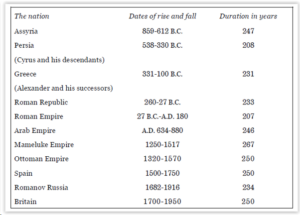
Source: ‘The Fate of Empires’ by Sir John Glubb, 1976.
In Glubb’s analysis, the rot sets in during ‘the Age of Affluence’:
“There does not appear to be any doubt that money is the agent which causes the decline of.. strong, brave and self-confident people. The decline in courage, enterprise and a sense of duty is, however, gradual. The first direction in which wealth injures the nation is a moral one. Money replaces honour and adventure as the objective of the best young men. Moreover, men do not normally seek to make money for their country or their community, but for themselves.
“Gradually, and almost imperceptibly, the Age of Affluence silences the voice of duty. The object of the young and the ambitious is no longer fame, honour or service, but cash. Education undergoes the same gradual transformation. No longer do schools aim at producing brave patriots ready to serve their country. Parents and students alike seek the educational qualifications which will command the highest salaries. The Arab moralist, Ghazali (1058-1111), complains in these very same words of the lowering of objectives in the declining Arab world of his time. Students, he says, no longer attend college to acquire learning and virtue, but to obtain those qualifications which will enable them to grow rich. The same situation is everywhere evident among us in the West today.”
Then, during what Glubb calls ‘High Noon’,
“The immense wealth accumulated in the nation dazzles the onlookers. Enough of the ancient virtues of courage, energy and patriotism survive to enable the state successfully to defend its frontiers. But, beneath the surface, greed for money is gradually replacing duty and public service.
“Indeed the change might be summarised as being from service to selfishness.
“Another outward change which invariably marks the transition from the Age of Conquests to the Age of Affluence is the spread of defensiveness. The nation, immensely rich, is no longer interested in glory or duty, but is only anxious to retain its wealth and its luxury. It is a period of defensiveness, from the Great Wall of China, to Hadrian’s Wall on the Scottish Border, to the Maginot Line in France in 1939.
“Money being in better supply than courage, subsidies instead of weapons are employed to buy off enemies. To justify this departure from ancient tradition, the human mind easily devises its own justification. Military readiness, or aggressiveness, is denounced as primitive and immoral. Civilised peoples are too proud to fight. The conquest of one nation by another is declared to be immoral.
“Empires are wicked. This intellectual device enables us to suppress our feeling of inferiority, when we read of the heroism of our ancestors, and then ruefully contemplate our position today. ‘It is not that we are afraid to fight,’ we say, ‘but we should consider it immoral.’ This even enables us to assume an attitude of moral superiority.
Then follows civil dissensions:
“Another remarkable and unexpected symptom of national decline is the intensification of internal political hatreds. One would have expected that, when the survival of the nation became precarious, political factions would drop their rivalry and stand shoulder-to-shoulder to save their country.”
Then follows an influx from abroad:
“..while the nation is still affluent, all the diverse races may appear equally loyal. But in an acute emergency, the immigrants will often be less willing to sacrifice their lives and their property than will be the original descendants of the founder race. Third, the immigrants are liable to form communities of their own, protecting primarily their own interests, and only in the second degree that of the nation as a whole.
“Fourth, many of the foreign immigrants will probably belong to races originally conquered by and absorbed into the empire. While the empire is enjoying its High Noon of prosperity, all these people are proud and glad to be imperial citizens. But when decline sets in, it is extraordinary how the memory of ancient wars, perhaps centuries before, is suddenly revived, and local or provincial movements appear demanding secession or independence.”
Society is overtaken by frivolity:
“As the nation declines in power and wealth, a universal pessimism gradually pervades the people, and itself hastens the decline. There is nothing succeeds like success, and, in the Ages of Conquest and Commerce, the nation was carried triumphantly onwards on the wave of its own self-confidence. Republican Rome was repeatedly on the verge of extinction—in 390 B.C. when the Gauls sacked the city and in 216 B.C. after the Battle of Cannae. But no disasters could shake the resolution of the early Romans. Yet, in the later stages of Roman decline, the whole empire was deeply pessimistic, thereby sapping its own resolution..
“The heroes of declining nations are always the same—the athlete, the singer or the actor. The word ‘celebrity’ today is used to designate a comedian or a football player, not a statesman, a general, or a literary genius.”
In the late stage of empire, Glubb highlights the role played by the provision of welfare:
“When the welfare state was first introduced in Britain, it was hailed as a new high-water mark in the history of human development. History, however, seems to suggest that the age of decline of a great nation is often a period which shows a tendency to philanthropy and to sympathy for other races. This phase may not be contradictory to the feeling described in the previous paragraph, that the dominant race has the right to rule the world. For the citizens of the great nation enjoy the role of Lady Bountiful. As long as it retains its status of leadership,
the imperial people are glad to be generous, even if slightly condescending. The rights of citizenship are generously bestowed on every race, even those formerly subject, and the equality of mankind is proclaimed. The Roman Empire passed through this phase, when equal citizenship was thrown open to all peoples, such provincials even becoming senators and emperors..
“It may perhaps be incorrect to picture the welfare state as the high-water mark of human attainment. It may merely prove to be one more regular milestone in the life story of an ageing and decrepit empire.”
Glubb concludes as follows:
“As numerous points of interest have arisen in the course of this essay, I close with a brief summary, to refresh the reader’s mind.
(a) We do not learn from history because our studies are brief and prejudiced.
(b) In a surprising manner, 250 years emerges as the average length of national greatness.
(c) This average has not varied for 3,000 years. Does it represent ten generations?
(d) The stages of the rise and fall of great nations seem to be:
The Age of Pioneers (outburst)
The Age of Conquests
The Age of Commerce
The Age of Affluence
The Age of Intellect
The Age of Decadence.
(e) Decadence is marked by:
Defensiveness
Pessimism
Materialism
Frivolity
An influx of foreigners
The Welfare State
A weakening of religion.
(f) Decadence is due to:
Too long a period of wealth and power
Selfishness
Love of money
The loss of a sense of duty.
(g) The life histories of great states are amazingly similar, and are due to internal factors.
(h) Their falls are diverse, because they are largely the result of external causes.
(i) History should be taught as the history of the human race, though of course with emphasis on the history of the student’s own country.”
Glubb’s analysis of the typical durations of empires (circa 250 years) is perhaps not to be taken too literally. We would merely observe that if we take the start of the American Empire as 1776 (the date of the Declaration of Independence), then readers may wish to consider the following mathematical formulation, namely 1776 + 250 = 2026.
In our piece ‘New Year’s Revolutions’ of 6th January 2024, we quoted Jeffrey Tucker of the Brownstone Institute:
“Finally, there is the loss of trust in everything: government, public health, pharmaceuticals, academia, science, media, and each other. Society cannot function without trust. Not even churches are immune from broad incredulity since most went along with the Covid response in every detail.
“This only begins to scratch the surface of what we’ve lost and what has replaced it. Ultimately all such tragedies come down to individual lives. These days you hear them only among friends and families. And they are terrible stories of sadness and personal despair. The pain is only intensified by the silence on the part of all corporate media, government, and other commanding heights. Because of the news block on the whole topic, there is mass and festering anger beneath the surface.”
We reiterate what we wrote in that earlier piece. We know where to point fingers. US and global alphabet agencies, unaccountable lobby groups with the pompous adjective ‘World’ affixed to their names, the UN, its laughable 2030 Agenda for Sustainable [sic] Development..
All of these agents of malevolent cretinocracy can be summarised simply as the grim return of the Big State.
“The state is a human institution, not a superhuman being. He who says “state” means coercion and compulsion. He who says: There should be a law concerning this matter, means: The armed men of the government should force people to do what they do not want to do, or not to do what they like. He who says: This law should be better enforced, means: The police should force people to obey this law. He who says: The state is God, deifies arms and prisons. The worship of the state is the worship of force. There is no more dangerous menace to civilization than a government of incompetent, corrupt, or vile men. The worst evils which mankind ever had to endure were inflicted by bad governments. The state can be and has often been in the course of history the main source of mischief and disaster.” (Ludwig von Mises, ‘Omnipotent Government’, 1944, Chapter 3).
Our formal brief, though, is not to advocate for political causes, but rather to act as responsible stewards of our clients’ valuable capital. This is not as easy as it sounds in an environment of deeply unsound money and in the run-up to monetary system regime change.
Monetary systems change all the time. They changed in 1914, for example, when the combatant powers all abandoned the gold standard, because staying on it whilst continuing to prosecute the war would have bankrupted them almost immediately. (Sound money saves lives.) They changed for the UK in September 1992 when the pound sterling was ethnically cleansed from Europe’s exchange rate mechanism because the UK could no longer bear to maintain the peg with the Deutsche Mark. And they will change in the months and years to come as the world increasingly comes to realise that the petrodollar is no longer the indisputed unchallengeable force in global finance given the offensive scale of the US’ unpayable debt burden.
So we seek safer harbours in assets (not the Big State’s liabilities) that are independent, scarce and permanent – gold and silver and sensibly priced mining companies amongst them.
Arguably the most important short assembly of words in the English language is the phrase ‘This Too Shall Pass’. Consider, for example, the cultural and economic situation of Britain in the 1970s. Stéphane Porion (‘Reassessing a turbulent decade’):
“Britain was hit throughout the 1970s by skyrocketing inflation and unemployment (stagflation, in other words), a wide range of strikes, power cuts, and states of emergency. Trade unions could be called “robber barons”, as they opposed the Conservatives’ statutory incomes policy and brought down the Conservative government, thereby answering the question asked by Edward Heath, when he called a general election in February 1974: “Who Governs Britain?” After 1975 they were also deemed responsible for tearing to pieces Labour’s Social Contract, paving the way for the 1978-1979 Winter of Discontent which in turn sealed the Labour Party’s defeat. British people suffered from a sense of despair and pessimism, while Britain struggled in the 1973 oil crisis and, on the brink of bankruptcy in 1976, was forced to ask for a loan from the IMF. At the same time, academics started to argue that the country was “ungovernable” or “dying”, while the power of the trade unions seemed impossible to curb.”
Or, as Dominic Sandbrook puts it (‘State of Emergency: The Way We Were’):
“The defining characteristics of the Seventies were economic disaster, terrorist threats, corruption in high places, prophecies of ecological doom and fear of the surveillance state’s suffocating embrace. The 1970s have merely been lurking, like a mad woman in the attic, waiting for a suitable moment when they can re-emerge and scare us out of our wits all over again.”
And then, at the 1979 General Election, Margaret Thatcher was elected, and she would go on to become the longest-serving British prime minister of the 20th century.
That we do not yet necessarily see the Margaret Thatcher of 2026 in Britain does not mean that she, or he (Nigel Farage ? Rupert Lowe ?), is not out there, quietly mustering resistance to the corrupt predations of the overlarge State. The unique energy of the genuine free market – as opposed to the crony corporatism that has largely held sway over recent years – is an endless capacity for reinvention.
“This, too, shall pass.”
………….
As you may know, we also manage bespoke investment portfolios for private clients internationally. We would be delighted to help you too. Because of the current heightened market volatility we are offering a completely free financial review, with no strings attached, to see if our value-oriented approach might benefit your portfolio – with no obligation at all:
Get your Free
financial review
…………
Tim Price is co-manager of the VT Price Value Portfolio and author of ‘Investing through the Looking Glass: a rational guide to irrational financial markets’. You can access a full archive of these weekly investment commentaries here. You can listen to our regular ‘State of the Markets’ podcasts, with Paul Rodriguez of ThinkTrading.com, here. Email us: info@pricevaluepartners.com.
Price Value Partners manage investment portfolios for private clients. We also manage the VT Price Value Portfolio, an unconstrained global fund investing in Benjamin Graham-style value stocks and real assets, and also in systematic trend-following funds.

“That men do not learn very much from the lessons of history is the most important of all the lessons of history.”
Get your Free
financial review
Why did the Roman Empire fall ? Historians continue to argue about the reasons for its collapse – a debate attaining added piquancy today given that western civilisation and culture appears to be following Rome over the cliff’s edge. Of the factors often cited for the fall of Rome, some seem to have uncanny echoes here in 2026, including:
As professional investors we might be expected to have a particular wariness for these last end-of-cycle characteristics. What would be wholly unique to our modern experience of crisis would be that it was deliberately triggered by the delusional beliefs of a warped doomsday cult – one that believed in anthropogenic climate change, the pursuit of ‘Net Zero’, and an unchallenged commitment to Diversity, Equity and Inclusion at the expense of any adherence to simple meritocracy.
Perhaps the defining characteristic of our current crisis is the raft of problems triggered by distant, unaccountable elitism. Catherine Liu (‘The Virtue Hoarders’):
“For as long as most of us can remember, the professional managerial class (PMC) has been fighting a class war, not against capitalists or capitalism, but against the working classes. Members of the PMC have memories of a time when they were more progressive—during the Progressive Era, specifically. They once supported working-class militancy in its epic struggles against robber barons and capitalists like Leland Stanford Jr., Andrew Carnegie, John D. Rockefeller, and Andrew Mellon, but today, they go to Stanford and view private foundations bearing those same names as models of philanthropy and sources of critical funding and recognition.
“They still believe themselves to be the heroes of history, fighting to defend innocent victims against their evil victimizers, but the working class is not a group they find worth saving, because by PMC standards, they do not behave properly: they are either disengaged politically or too angry to be civil. Liberal members of the credentialed classes love to use the word empower when they talk about “people,” but the use of that verb objectifies the recipients of their help while implying that the people have no access to power without them.
“The PMC as a proxy for today’s ruling class is shameless about hoarding all forms of secularized virtue: whenever it addresses a political and economic crisis produced by capitalism itself, the PMC reworks political struggles for policy change and redistribution into individual passion plays, focusing its efforts on individual acts of “giving back” or reified forms of self-transformation. It finds in its particular tastes and cultural proclivities the justification for its unshakable sense of superiority to ordinary working-class people.
“If its politics amount to little more than virtue signalling, it loves nothing more than moral panics to incite its members to ever more pointless forms of pseudo-politics and hypervigilance. The much-maligned Hillary Clinton was honest in her contempt for ordinary people when, in 2016, she dismissed Trump supporters as “deplorables.” Their 2016 defiance of PMC and liberal nostra has only hardened into reactionary antiauthoritarianism, which another reactionary demagogue will seek to exploit.
“PMC virtue hoarding is the insult added to injury when white-collar managers, having downsized their blue-collar workforce, then disparage them for their bad taste in literature, bad diets, unstable families, and deplorable child-rearing habits. When the PMC sympathized with the plight of masses of working people, it also pioneered professional standards of research grounded in professional organizations like the American Medical Association, the Association of University Professors, and all the professional organizations that currently dominate academic life. In organizing professional life, the PMC tried to protect the integrity of specialists and experts against the power of capitalists and the markets.. Those heady days of PMC heroism are long gone. The PMC, with its professional discipline and aura of disinterestedness, did very well for itself during the Depression, during World War II, and in the postwar period with the expansion of universities and the growing complexity of the American and social economic order.
“When the tide turned against American workers, the PMC preferred to fight culture wars against the classes below while currying the favour of capitalists it once despised.. The post-1968 PMC elite has become ideologically convinced of its own unassailable position as comprising the most advanced people the earth has ever seen. They have, in fact, made a virtue of their vanguardism. Drawing on the legacy of the counterculture and its commitment to technological and spiritual innovations, PMC elites try to tell the rest of us how to live, and in large part, they have succeeded in destroying and building in its own image the physical and now cybernetic infrastructure of our everyday lives.
“As the fortunes of the PMC elites rose, the class insisted on its ability to do ordinary things in extraordinary, fundamentally superior and more virtuous ways: as a class, it was reading books, raising children, eating food, staying healthy, and having sex as the most culturally and affectively advanced people in human history..
“Although the PMC is profoundly secular in nature, its rhetorical tone is pseudo-religious. While the PMC infuriates conservative Christians with its media monopoly on liberal righteousness, it finds salvation, like most Protestant sects, in material and earthly success. In liberal circles, talking about class or class consciousness before other forms of difference is not just controversial; it is heretical. They call you a “class reductionist” if you argue that race, gender, and class are not interchangeable categories. They pile on with the legalistic and deadly term intersectional to accommodate the materialist critique of their politics.
“The PMC simply does not want its class identity or interests unmasked. Young people wanting to enter what the Ehrenreichs called the “liberal professions” and gain positions in academia and the culture and media industries have had to adapt themselves to the Procrustean bed of PMC-dominated networks of influence..
“It wants to play the virtuous social hero, but as a class, it is hopelessly reactionary. The interests of the PMC are now tied more than ever to its corporate overlords than to the struggles of the majority of Americans whose suffering is merely background décor for the PMC’s elite volunteerism. Members of the PMC soften the sharpness of their guilt about collective suffering by stroking their credentials and telling themselves that they are better and more qualified to lead and guide than other people. PMC centrism is a powerful ideology. Its priorities in research and innovation have been shaped more and more by corporate interests and the profit motive, while in the humanities and social sciences, scholars are rewarded by private foundations for their general disregard for historical knowledge, not to mention historical materialism.
“The rewards for following ruling-class directives are just too great, but the intellectual and psychic price that has to be paid for compliance should be too high for any member of society. In academia, the American PMC has achieved a great deal in establishing the rigors of peer review consensus and research autonomy, but we can no longer afford to defend its cherished principle of epistemological neutrality as a secret weapon against “extremism.” We live in a political, environmental, and social emergency: class war over distribution of resources is the critical battle of our times.”
Academia has undoubtedly been problematic, but recent years point an even more damning finger against science and scientism (“an exaggerated trust in the efficacy of the methods of natural science applied to all areas of investigation”). As the author Ian Hall points out in his jeremiad against climate-change advocates, Unsettled Science, the scientific lobby was largely enabled by President Truman after America’s victory in the Second World War; the winding down of the Manhattan Project that helped develop the atom bomb led to 130,000 scientists being put out of work. And so began the era of government research contracts. This is not to say that all climate scientists are hopelessly conflicted by dint of their addiction to money from the ‘Big State’, only to suggest that, as Ian Hall advises, a philosophy of ‘follow the money’ may well explain some of the professional behaviours and strong feelings linked to the topic of climate change. When you’re paid to follow the party line, you follow the party line. Hall cites President Eisenhower in his parting address of 1961 (the emphasis is ours):
“Yet in holding scientific discovery in respect, as we should, we must also be alert to the equal and opposite danger that public policy could itself become the captive of a scientific-technological elite.”
The danger in hewing to an academic consensus with a strong political agenda can also be seen, for example, in a) how academia almost universally came out in favour of ‘Remain’; and b) how most economists, being in the pay of either investment banks or lobby groups with financial connections to the Big State, remain unreconstructed neo-Keynesians (i.e. they believe in tax-and-spend policies and aggressive money printing). At a MoneyWeek annual investor conference several years ago, for example, we were struck by the consensus among the associated panellists that modern monetary theory (MMT) – essentially, endless money printing and inflation be damned – was alive and well and heading to a central bank near you. There was a helpful letter to the Financial Times from a Mr. George Hatjoullis back in November 2014 that explains some of the dangers of MMT:
“Sir, Adair Turner suggests some version of monetary financing is the only way to break Japan’s deflation and deal with the debt overhang (‘Print money to fund the deficit – that is the fastest way to raise rates’, Comment, November 11). This was precisely how Korekiyo Takahashi, Japanese finance minister from 1931 to 1936, broke the deflation of the 1930s. The policy was discredited because of the hyperinflation that followed.” [Emphasis, again, ours.]
Don’t get us wrong. We are not stating that climate change is not real. We are merely confessing that we don’t know enough about the science to make an informed judgment. But to have a properly informed opinion on climate change requires us all to be experts in astrophysics, astronomy, geology, meteorology, physics, chemistry, ecology, zoology and economics..
We do, however, admit to being climate sceptics. Is our climate changing? Perhaps. Is human activity responsible for that change? We don’t know. If human activity is to blame for climate change, can we reverse that change? We don’t know. What we do know is that the most powerful energy source in our solar system, by some margin, is the sun. Anthropogenic climate change may well be real for all we know, but we are more interested in the effect of cycles in solar activity since – directly or indirectly – that’s where most of the world’s heat, light and energy actually comes from. And trying to prevent the developing world from materially advancing – in part through the use of polluting fossil fuels – seems a particularly imperious way of hoisting the ladder of progress up behind you, once your own country has already attained meaningful commercial wealth.
In the context of the green energy debate, Doomberg has been a consistent voice of sanity. From a recent essay, ‘Mission Impossible’:
“Germany’s swan dive off the energy cliff is a striking example of Mass Dissonance™, a phenomenon under which entire societies believe things provably at odds with physics, truth tellers are ostracized as heretics, and real-world nullification of tightly held dogmas are twisted into proof of the need to double down on the absurdity. It was always impossible for Germany to execute Energiewende without collapsing the standard of living of its citizens, and the moment the latter could no longer be protected from the former, Germany retreated to the coal mines with a swiftness and efficiency on par with the British evacuation from Dunkirk.
“Imagine if Germany had not scrambled to bring their coal plants back online as quickly as they did. Imagine if Thunberg had gotten her way. As we type this piece, more than 40% of Germany’s electricity is being produced by coal. Unplug those coal-fired power plants tomorrow and chaos of historic proportions would quickly follow..
“We surely won’t be alone in noting that Mass Dissonance™ on energy fundamentals is the ultimate expression of affluence and excess. To the vast swathes of humanity struggling at the base of Maslow’s pyramid of needs, the West’s obsession with pretending that impossible goals are achievable while wasting enormous resources in their fruitless pursuit must seem utterly incomprehensible.
“We simply cannot electrify our transportation sector and back up our electricity grid to any meaningful extent using batteries, and therefore we won’t.”
Climate-change advocates seem to us disturbingly millenarian (i.e. they believe in a forthcoming transformation of society). A good example of a similar ‘doomsday cult’ is the Millerites, who followed the teachings of William Miller. We have written of the Millerites before, and doubtless will again, until the threat of similar cultists has abated.
Born in Massachusetts in 1782, William Miller predicted that the world would end in April 1843. Miller had served in the War of 1812 against the British and ultimately became a Baptist preacher. No doubt influenced by his war-time experiences, he became obsessed with death and the afterlife. After the war he devoted 15 years of his life to study of the Bible. During this period, a number of movements sprang up – influenced perhaps by economic crises (such as the recession that followed the Panic of 1837) or the growing social tensions that would in time erupt in the Civil War.
Miller based his analysis on Daniel 8:14, which states that: “Unto two thousand and three hundred days; then shall the sanctuary be cleansed.”
He then used a contentious “day-year principle,” by which a day in Biblical prophecy became reinterpreted as a calendar year. By this reckoning, and using the starting point as the decree to rebuild Jerusalem by Artaxerxes I of Persia in 457 BC, Miller concluded that the second coming would occur on or around 1843. In a letter to his brother, Miller predicted that Christ would come:
“…in the glory of God, in the clouds of Heaven, with all the saints and angels, change the bodies of all that are alive on Earth that are his, and both the living and the raised saints will be caught up to meet the Lord in the air.”
As for those left behind, the outlook was not quite so benign. Miller forecast that the Earth would be
“…cleansed by fire, the elements will melt with fervent heat, the works of men will be destroyed, the bodies of the wicked will be burned to ashes.”
The wicked – those who rejected the Gospel – would not only die, but their spirits would be banished from the Earth, “shut up in the pit”, and not allowed to return to Earth for a thousand years.
The arrival of an extremely bright comet in 1843 bolstered fears of an impending apocalypse. Although reluctant to identify a specific date for the Day of Judgment, Miller finally settled on April 23, 1843.
April 23, of course, came and went without incident.
Miller concluded that he had erred in using solar years instead of lunar years, and came up with a replacement date for the end of days, namely March 21, 1844. The Millerites, as they were now known, purchased an enormous tent capable of accommodating more than 2,000 people, and were said to have bought “ascension robes” in preparation for their heavenly journey.
When March 21 came and went without incident, the Millerites plumped for October 22, on the basis that it was also the date of Yom Kippur.
When October 22 came and went without incident, Miller and his associate Joshua Himes embraced a new cause, namely to raise money for Millerites who had given up everything including their jobs and possessions to prepare for the end. Thus began a period known as “the Great Disappointment”. A more expansive list of delusional ‘end of days’ predictions is available here.
The British philosopher John Gray a few years ago recorded an audio essay for BBC Radio 4 in which he suggested that “…the belief that an end to history is imminent never really goes away.” Gray compared the antics of the likes of climate-change pressure group Extinction Rebellion to those of previous Armageddonists such as the Millerites. And then, of course, there is the cult of Greta…
We have no problem with healthy debate. We have a big problem, however, with being compelled to act (and invest) in a certain way simply because the chattering classes deem it socially and culturally obligatory to do so. Can paying more tax to politicians really change the weather ? Fund managers are already being urged to draft statements of their ESG (environmental, social and governance) policy commitments. This seems dangerously faddish and subjective to us, perhaps because we are old enough to remember the 1970s, when we were all being warned of an impending new Ice Age.
For as long as it remains legal to do so, we fully intend to take advantage of attractive valuations in the commodity and energy-extraction space – particularly since the activities of people like Greta Thunberg and her related moral panickers have driven the share prices of companies in these sectors, in many cases, to extremely desirable levels. Gold, for example, makes eminent sense as a store of value in economically turbulent and inflationary times. But if we’ve done our homework correctly, sensibly priced precious metals and commodities miners may yet be on the cusp of some truly historic bull trends – which we have every intention of exploiting. Adversity and decline may still yield opportunity.
No wider discussion of the fate of imperial Rome can be complete without reference to Sir John Glubb’s short history ‘The Fate of Empires’. A key takeaway from this intriguing study is that many empires throughout history share astonishingly similar durations.
Source: ‘The Fate of Empires’ by Sir John Glubb, 1976.
In Glubb’s analysis, the rot sets in during ‘the Age of Affluence’:
“There does not appear to be any doubt that money is the agent which causes the decline of.. strong, brave and self-confident people. The decline in courage, enterprise and a sense of duty is, however, gradual. The first direction in which wealth injures the nation is a moral one. Money replaces honour and adventure as the objective of the best young men. Moreover, men do not normally seek to make money for their country or their community, but for themselves.
“Gradually, and almost imperceptibly, the Age of Affluence silences the voice of duty. The object of the young and the ambitious is no longer fame, honour or service, but cash. Education undergoes the same gradual transformation. No longer do schools aim at producing brave patriots ready to serve their country. Parents and students alike seek the educational qualifications which will command the highest salaries. The Arab moralist, Ghazali (1058-1111), complains in these very same words of the lowering of objectives in the declining Arab world of his time. Students, he says, no longer attend college to acquire learning and virtue, but to obtain those qualifications which will enable them to grow rich. The same situation is everywhere evident among us in the West today.”
Then, during what Glubb calls ‘High Noon’,
“The immense wealth accumulated in the nation dazzles the onlookers. Enough of the ancient virtues of courage, energy and patriotism survive to enable the state successfully to defend its frontiers. But, beneath the surface, greed for money is gradually replacing duty and public service.
“Indeed the change might be summarised as being from service to selfishness.
“Another outward change which invariably marks the transition from the Age of Conquests to the Age of Affluence is the spread of defensiveness. The nation, immensely rich, is no longer interested in glory or duty, but is only anxious to retain its wealth and its luxury. It is a period of defensiveness, from the Great Wall of China, to Hadrian’s Wall on the Scottish Border, to the Maginot Line in France in 1939.
“Money being in better supply than courage, subsidies instead of weapons are employed to buy off enemies. To justify this departure from ancient tradition, the human mind easily devises its own justification. Military readiness, or aggressiveness, is denounced as primitive and immoral. Civilised peoples are too proud to fight. The conquest of one nation by another is declared to be immoral.
“Empires are wicked. This intellectual device enables us to suppress our feeling of inferiority, when we read of the heroism of our ancestors, and then ruefully contemplate our position today. ‘It is not that we are afraid to fight,’ we say, ‘but we should consider it immoral.’ This even enables us to assume an attitude of moral superiority.
Then follows civil dissensions:
“Another remarkable and unexpected symptom of national decline is the intensification of internal political hatreds. One would have expected that, when the survival of the nation became precarious, political factions would drop their rivalry and stand shoulder-to-shoulder to save their country.”
Then follows an influx from abroad:
“..while the nation is still affluent, all the diverse races may appear equally loyal. But in an acute emergency, the immigrants will often be less willing to sacrifice their lives and their property than will be the original descendants of the founder race. Third, the immigrants are liable to form communities of their own, protecting primarily their own interests, and only in the second degree that of the nation as a whole.
“Fourth, many of the foreign immigrants will probably belong to races originally conquered by and absorbed into the empire. While the empire is enjoying its High Noon of prosperity, all these people are proud and glad to be imperial citizens. But when decline sets in, it is extraordinary how the memory of ancient wars, perhaps centuries before, is suddenly revived, and local or provincial movements appear demanding secession or independence.”
Society is overtaken by frivolity:
“As the nation declines in power and wealth, a universal pessimism gradually pervades the people, and itself hastens the decline. There is nothing succeeds like success, and, in the Ages of Conquest and Commerce, the nation was carried triumphantly onwards on the wave of its own self-confidence. Republican Rome was repeatedly on the verge of extinction—in 390 B.C. when the Gauls sacked the city and in 216 B.C. after the Battle of Cannae. But no disasters could shake the resolution of the early Romans. Yet, in the later stages of Roman decline, the whole empire was deeply pessimistic, thereby sapping its own resolution..
“The heroes of declining nations are always the same—the athlete, the singer or the actor. The word ‘celebrity’ today is used to designate a comedian or a football player, not a statesman, a general, or a literary genius.”
In the late stage of empire, Glubb highlights the role played by the provision of welfare:
“When the welfare state was first introduced in Britain, it was hailed as a new high-water mark in the history of human development. History, however, seems to suggest that the age of decline of a great nation is often a period which shows a tendency to philanthropy and to sympathy for other races. This phase may not be contradictory to the feeling described in the previous paragraph, that the dominant race has the right to rule the world. For the citizens of the great nation enjoy the role of Lady Bountiful. As long as it retains its status of leadership,
the imperial people are glad to be generous, even if slightly condescending. The rights of citizenship are generously bestowed on every race, even those formerly subject, and the equality of mankind is proclaimed. The Roman Empire passed through this phase, when equal citizenship was thrown open to all peoples, such provincials even becoming senators and emperors..
“It may perhaps be incorrect to picture the welfare state as the high-water mark of human attainment. It may merely prove to be one more regular milestone in the life story of an ageing and decrepit empire.”
Glubb concludes as follows:
“As numerous points of interest have arisen in the course of this essay, I close with a brief summary, to refresh the reader’s mind.
(a) We do not learn from history because our studies are brief and prejudiced.
(b) In a surprising manner, 250 years emerges as the average length of national greatness.
(c) This average has not varied for 3,000 years. Does it represent ten generations?
(d) The stages of the rise and fall of great nations seem to be:
The Age of Pioneers (outburst)
The Age of Conquests
The Age of Commerce
The Age of Affluence
The Age of Intellect
The Age of Decadence.
(e) Decadence is marked by:
Defensiveness
Pessimism
Materialism
Frivolity
An influx of foreigners
The Welfare State
A weakening of religion.
(f) Decadence is due to:
Too long a period of wealth and power
Selfishness
Love of money
The loss of a sense of duty.
(g) The life histories of great states are amazingly similar, and are due to internal factors.
(h) Their falls are diverse, because they are largely the result of external causes.
(i) History should be taught as the history of the human race, though of course with emphasis on the history of the student’s own country.”
Glubb’s analysis of the typical durations of empires (circa 250 years) is perhaps not to be taken too literally. We would merely observe that if we take the start of the American Empire as 1776 (the date of the Declaration of Independence), then readers may wish to consider the following mathematical formulation, namely 1776 + 250 = 2026.
In our piece ‘New Year’s Revolutions’ of 6th January 2024, we quoted Jeffrey Tucker of the Brownstone Institute:
“Finally, there is the loss of trust in everything: government, public health, pharmaceuticals, academia, science, media, and each other. Society cannot function without trust. Not even churches are immune from broad incredulity since most went along with the Covid response in every detail.
“This only begins to scratch the surface of what we’ve lost and what has replaced it. Ultimately all such tragedies come down to individual lives. These days you hear them only among friends and families. And they are terrible stories of sadness and personal despair. The pain is only intensified by the silence on the part of all corporate media, government, and other commanding heights. Because of the news block on the whole topic, there is mass and festering anger beneath the surface.”
We reiterate what we wrote in that earlier piece. We know where to point fingers. US and global alphabet agencies, unaccountable lobby groups with the pompous adjective ‘World’ affixed to their names, the UN, its laughable 2030 Agenda for Sustainable [sic] Development..
All of these agents of malevolent cretinocracy can be summarised simply as the grim return of the Big State.
“The state is a human institution, not a superhuman being. He who says “state” means coercion and compulsion. He who says: There should be a law concerning this matter, means: The armed men of the government should force people to do what they do not want to do, or not to do what they like. He who says: This law should be better enforced, means: The police should force people to obey this law. He who says: The state is God, deifies arms and prisons. The worship of the state is the worship of force. There is no more dangerous menace to civilization than a government of incompetent, corrupt, or vile men. The worst evils which mankind ever had to endure were inflicted by bad governments. The state can be and has often been in the course of history the main source of mischief and disaster.” (Ludwig von Mises, ‘Omnipotent Government’, 1944, Chapter 3).
Our formal brief, though, is not to advocate for political causes, but rather to act as responsible stewards of our clients’ valuable capital. This is not as easy as it sounds in an environment of deeply unsound money and in the run-up to monetary system regime change.
Monetary systems change all the time. They changed in 1914, for example, when the combatant powers all abandoned the gold standard, because staying on it whilst continuing to prosecute the war would have bankrupted them almost immediately. (Sound money saves lives.) They changed for the UK in September 1992 when the pound sterling was ethnically cleansed from Europe’s exchange rate mechanism because the UK could no longer bear to maintain the peg with the Deutsche Mark. And they will change in the months and years to come as the world increasingly comes to realise that the petrodollar is no longer the indisputed unchallengeable force in global finance given the offensive scale of the US’ unpayable debt burden.
So we seek safer harbours in assets (not the Big State’s liabilities) that are independent, scarce and permanent – gold and silver and sensibly priced mining companies amongst them.
Arguably the most important short assembly of words in the English language is the phrase ‘This Too Shall Pass’. Consider, for example, the cultural and economic situation of Britain in the 1970s. Stéphane Porion (‘Reassessing a turbulent decade’):
“Britain was hit throughout the 1970s by skyrocketing inflation and unemployment (stagflation, in other words), a wide range of strikes, power cuts, and states of emergency. Trade unions could be called “robber barons”, as they opposed the Conservatives’ statutory incomes policy and brought down the Conservative government, thereby answering the question asked by Edward Heath, when he called a general election in February 1974: “Who Governs Britain?” After 1975 they were also deemed responsible for tearing to pieces Labour’s Social Contract, paving the way for the 1978-1979 Winter of Discontent which in turn sealed the Labour Party’s defeat. British people suffered from a sense of despair and pessimism, while Britain struggled in the 1973 oil crisis and, on the brink of bankruptcy in 1976, was forced to ask for a loan from the IMF. At the same time, academics started to argue that the country was “ungovernable” or “dying”, while the power of the trade unions seemed impossible to curb.”
Or, as Dominic Sandbrook puts it (‘State of Emergency: The Way We Were’):
“The defining characteristics of the Seventies were economic disaster, terrorist threats, corruption in high places, prophecies of ecological doom and fear of the surveillance state’s suffocating embrace. The 1970s have merely been lurking, like a mad woman in the attic, waiting for a suitable moment when they can re-emerge and scare us out of our wits all over again.”
And then, at the 1979 General Election, Margaret Thatcher was elected, and she would go on to become the longest-serving British prime minister of the 20th century.
That we do not yet necessarily see the Margaret Thatcher of 2026 in Britain does not mean that she, or he (Nigel Farage ? Rupert Lowe ?), is not out there, quietly mustering resistance to the corrupt predations of the overlarge State. The unique energy of the genuine free market – as opposed to the crony corporatism that has largely held sway over recent years – is an endless capacity for reinvention.
“This, too, shall pass.”
………….
As you may know, we also manage bespoke investment portfolios for private clients internationally. We would be delighted to help you too. Because of the current heightened market volatility we are offering a completely free financial review, with no strings attached, to see if our value-oriented approach might benefit your portfolio – with no obligation at all:
Get your Free
financial review
…………
Tim Price is co-manager of the VT Price Value Portfolio and author of ‘Investing through the Looking Glass: a rational guide to irrational financial markets’. You can access a full archive of these weekly investment commentaries here. You can listen to our regular ‘State of the Markets’ podcasts, with Paul Rodriguez of ThinkTrading.com, here. Email us: info@pricevaluepartners.com.
Price Value Partners manage investment portfolios for private clients. We also manage the VT Price Value Portfolio, an unconstrained global fund investing in Benjamin Graham-style value stocks and real assets, and also in systematic trend-following funds.
Take a closer look
Take a look at the data of our investments and see what makes us different.
LOOK CLOSERSubscribe
Sign up for the latest news on investments and market insights.
KEEP IN TOUCHContact us
In order to find out more about PVP please get in touch with our team.
CONTACT USTim Price