“There are decades where nothing happens; and there are weeks where decades happen.”
- Attributed to Vladimir Ilyich Lenin.
Get your Free
financial review
The world changed profoundly just four years ago. In February 2022, in response to Russia’s invasion of Ukraine, the West immobilised roughly $300 billion of Russia’s foreign reserves. At the end of the month, both the EU and the US froze Russian central bank assets in Europe and the US.
This may go down in history as one of the biggest unforced geopolitical errors of the 21st Century. So far.
When, like the US, you have official national debts of $40 trillion that will never be paid except in devalued money, it looks almost churlish to remind generous foreign strangers that their holdings of your ‘assets’ can be voided on a whim. But that’s what they did. The decision triggered an understandable exodus of foreign sovereign capital out of the US Treasury bond market and into a stateless asset that is nobody’s liability: gold.
That exodus is continuing, and the increasingly farcical Iran conflict isn’t helping. Jeremy McKeown:
“In a world suddenly full of uncertainty of ownership with invoices that no one intends to honour, watch where the real money goes to settle up. It’s going to gold, which cleared $4,400 for the first time in two months yesterday, and look who’s buying. This isn’t a rate trade; gold is rising even as oil pushes rate-hike fears higher. This is certainty of ownership and good title.”
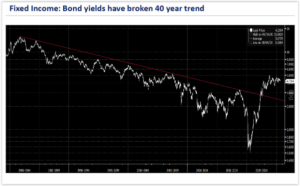
The following graph is probably the most significant in our current presentation to institutional clients (free copy available on demand). It shows that 10 year US Treasury bond yields recently broke up through a 40 year downtrend. What that means is that a benign 40 year period for interest rates, bonds, stocks and property just ended. That has implications.
Source: Bloomberg.
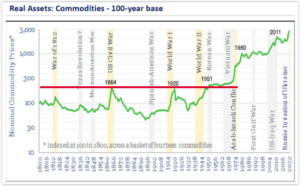
The biggest technical break-out in history was that of commodities prices in the 1970s, helped by the Nixon gold shock and the Arab oil embargo of the West, during which commodities markets rose sharply higher through resistance that had been consolidating for a century. Reminder: during the 1970s, commodities were the only place to be, because stocks and bonds were a disaster. Perhaps history is in the process of repeating itself ?
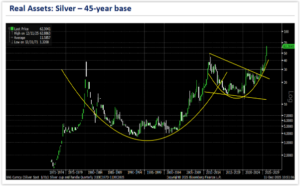
The second biggest technical breakout in history took place a few months ago, in silver. Although silver prices have subsequently corrected, we think it’s salutary to recall that as the most conductive metal in the world, silver plays a vital role in the modern digital economy, and yet has been in physical deficit for the last six years. In short, we think silver is going way higher, and that silver miners are the cheapest sector within the global equity markets by far, and we are therefore positioned accordingly.
Source: Bloomberg
It is not just about price – it is also, more fundamentally, about access, especially with regards to the monetary metals, gold and silver. Dr. David Martin, in ‘What’s in your vault ?’:
“Around the world, central banks have begun bringing gold home. Not merely purchasing gold, though that is certainly occurring, but repatriating it. Bullion that once rested comfortably in the vaults of London and New York is being moved into domestic custody. Public explanations invoke geopolitical uncertainty, sanctions exposure, strategic resilience, and sovereign security. None of those explanations are incorrect. They are simply incomplete. They describe the circumstances without illuminating the realization that appears to be driving the behavior.
“A gold bar in your vault is not the same thing as a claim upon a gold bar in someone else’s vault. Since the Templars in Jerusalem communicating with the courts of Europe, promises are not the thing that’s promised. They never were.
“For decades that distinction could be ignored because confidence in the system remained sufficiently high that possession appeared unnecessary. The custodians were trusted. The networks functioned. The legal frameworks appeared durable. The infrastructure seemed permanent. Under those conditions, claims and assets could masquerade as equivalents because the distance between them was rarely tested. Yet every system eventually encounters moments when assumptions become visible. The freezing of sovereign reserves reveals that ownership and access are not identical. Financial crises reveal that liquidity and solvency are not identical. Infrastructure failures reveal that existence and availability are not identical. Again and again reality intrudes upon abstraction and reminds us that the world beneath the ledger still matters.
“This is why the movement of gold deserves more attention than the declarations of economists, politicians, central bankers, or global forums. The repatriation of gold is not fundamentally a commodity story, an inflation story, or even a monetary story. It is a custody story. It is a sovereignty story. It is an acknowledgment that possession remains the final court of appeal whenever confidence begins to wobble.
“The irony is difficult to miss. At precisely the moment civilization celebrates digital currencies, tokenized assets, algorithmic settlement systems, cloud-based records, and increasingly abstract forms of ownership, many of the institutions responsible for preserving national wealth appear to be moving in the opposite direction. [Emphasis ours.] Public narratives race toward virtuality while institutional behavior quietly migrates toward physical custody. The speeches point toward digitization while the bullion trucks point toward reality.
“Perhaps nowhere does this contradiction become more visible than when contemplating the fragility of the infrastructure upon which modern finance rests. We speak confidently of balances, portfolios, reserves, pensions, derivatives, and increasingly digital assets as though they possess an existence independent of the systems that record them. Yet the entire architecture rests upon a remarkably delicate foundation of electricity, communications, computation, synchronization, and trust. We have become so accustomed to continuity that we mistake continuity for permanence.
“Consider not catastrophe but interruption. Consider a Carrington-scale solar event, a successful cyberattack, a cascading grid failure, or an electromagnetic pulse. The specific mechanism matters less than the principle. The lights go out. The servers stop responding. The networks cease synchronizing. The endless choreography of verification pauses. Legal claims may survive. Contracts may survive. Accounting entries may survive. Yet the practical ability to verify, transfer, access, or exercise those claims becomes uncertain. The abstractions remain theoretically intact while becoming functionally irrelevant.
“Gold occupies a peculiar place within this thought experiment because it exists outside the thought experiment. It requires no password, no network connection, no authentication server, no intermediary, and no continuous electrical infrastructure to affirm its existence. The ledger may disappear. The gold remains. Whether one views gold as a monetary asset, a strategic reserve, or simply a historical curiosity, its persistence reveals something deeper about the nature of value itself. Assets that derive their existence from the systems that record them are fundamentally different from assets that exist independently of those systems.
“What fascinates me, however, is not the rhetoric surrounding the so-called Great Reset, because the phrase itself has become one of the most effective distractions of the modern era. During the COVID years, populations were conditioned into increasingly reflexive forms of polarization in which every issue was immediately translated into opposing camps, every observation became a declaration of allegiance, and every question became a test of ideological loyalty. One side treated the Great Reset as evidence of a coordinated conspiracy while the other dismissed it as evidence of irrational paranoia. Both reactions produced the same outcome. Attention became fixed upon the slogan while remaining safely distant from the structure beneath it.
“History has never required a committee to produce a reset. Resets emerge whenever claims become sufficiently detached from assets, whenever promises become sufficiently detached from productive capacity, whenever leverage becomes sufficiently detached from resilience, and whenever abstractions become sufficiently detached from reality. Long before a reset acquires a name, it exists as a tension embedded within the architecture itself.
“This is why the most revealing actions in history are rarely the ones announced from podiums. They are the quiet movements that occur beneath the rhetoric. While populations argue over narratives, central banks move bullion. While commentators debate ideology, nations secure custody. While attention remains fixed upon political theater, the custodians of monetary power appear to be asking an older and more fundamental question concerning what survives when confidence falters, when access becomes uncertain, and when the systems responsible for recording ownership can no longer be assumed to function exactly as they did yesterday.
“History repeatedly demonstrates that major transitions rarely emerge from the causes later assigned to them. Wars, sovereign defaults, financial crises, technological disruptions, infrastructure failures, and natural disasters frequently function as explanatory narratives that make visible contradictions that had already been accumulating for decades. The triggering event receives the blame because it is easier to understand than the architecture that rendered the event consequential. Yet the architecture is always where the real story resides. The event merely exposes what was already true.
“Seen from this perspective, the most important question is not whether a particular organization intends to implement a Great Reset. The more important question concerns the conditions under which resets become inevitable. Whenever claims multiply faster than assets, whenever obligations expand faster than productive capacity, whenever financial abstractions drift sufficiently far from physical realities, tensions accumulate that eventually demand reconciliation. That reconciliation may arrive through inflation, restructuring, default, crisis, technological disruption, or events conveniently attributed to forces beyond human control, but the mechanism remains secondary to the principle. Reality eventually reasserts itself because reality is the only foundation upon which any abstraction can ultimately stand.
“Viewed through that lens, the repatriation of gold appears less like a financial decision than an institutional acknowledgment that the distinction between claims and assets still matters. It represents a quiet recognition that resilience and possession acquire increasing importance precisely when complexity and uncertainty begin to rise. It suggests that beneath the public narratives, beneath the political theater, and beneath the endless distractions that dominate contemporary discourse, some of the world’s most consequential actors may be asking the same question that inspired an essay sixteen years ago. What do you actually possess when the systems recording possession become uncertain?
“The question is not fundamentally about gold. It is not fundamentally about vaults. It is not fundamentally about central banks. It is a question about the difference between a thing and a description of a thing, between ownership and access, between claims and assets, between abstractions and realities. It is the question that emerges whenever a civilization becomes sufficiently dependent upon representations that it forgets to examine the realities those representations are intended to describe.
“Sixteen years ago I asked what was in your wallet. Watching nations quietly move bullion across oceans and into sovereign custody, the question feels sharper today than it did then. Not because the answer has changed, but because the institutions themselves appear increasingly unwilling to pretend that a claim and an asset are the same thing. The distinction sounded eccentric in 2010. It sounds increasingly obvious in 2026. The most interesting question is whether the rest of us will recognize the significance of that realization before history once again forces the issue on its own terms.”
In a world where trust in institutions is taking a mauling, own high trust assets. Gold and silver are the nonpareil, but hard assets in general have the edge, in our view, over tokenised confidence tricks. We are therefore expanding our commodities exposure beyond metals into arenas like energy and forestry.
There are weeks when decades happen. The end of February 2022 was one of them. The decade it ushered in was effectively a tribute act for the stagflationary 1970s – during which equities and bonds both collapsed, and commodities were star outperformers. Choose your assets accordingly.
………….
As you may know, we also manage bespoke investment portfolios for private clients internationally. We would be delighted to help you too. Because of the current heightened market volatility we are offering a completely free financial review, with no strings attached, to see if our value-oriented approach might benefit your portfolio – with no obligation at all:
Get your Free
financial review
…………
Tim Price is co-manager of the VT Price Value Portfolio and author of ‘Investing through the Looking Glass: a rational guide to irrational financial markets’. You can access a full archive of these weekly investment commentaries here. You can listen to our regular ‘State of the Markets’ podcasts, with Paul Rodriguez of ThinkTrading.com, here. Email us: info@pricevaluepartners.com.
Price Value Partners manage investment portfolios for private clients. We also manage the VT Price Value Portfolio, an unconstrained global fund investing in Benjamin Graham-style value stocks and real assets, and also in systematic trend-following funds. The fund was “Highly commended” in Investment Week’s 2026 Fund Manager of the Year Awards.

“There are decades where nothing happens; and there are weeks where decades happen.”
Get your Free
financial review
The world changed profoundly just four years ago. In February 2022, in response to Russia’s invasion of Ukraine, the West immobilised roughly $300 billion of Russia’s foreign reserves. At the end of the month, both the EU and the US froze Russian central bank assets in Europe and the US.
This may go down in history as one of the biggest unforced geopolitical errors of the 21st Century. So far.
When, like the US, you have official national debts of $40 trillion that will never be paid except in devalued money, it looks almost churlish to remind generous foreign strangers that their holdings of your ‘assets’ can be voided on a whim. But that’s what they did. The decision triggered an understandable exodus of foreign sovereign capital out of the US Treasury bond market and into a stateless asset that is nobody’s liability: gold.
That exodus is continuing, and the increasingly farcical Iran conflict isn’t helping. Jeremy McKeown:
“In a world suddenly full of uncertainty of ownership with invoices that no one intends to honour, watch where the real money goes to settle up. It’s going to gold, which cleared $4,400 for the first time in two months yesterday, and look who’s buying. This isn’t a rate trade; gold is rising even as oil pushes rate-hike fears higher. This is certainty of ownership and good title.”
The following graph is probably the most significant in our current presentation to institutional clients (free copy available on demand). It shows that 10 year US Treasury bond yields recently broke up through a 40 year downtrend. What that means is that a benign 40 year period for interest rates, bonds, stocks and property just ended. That has implications.
Source: Bloomberg.
The biggest technical break-out in history was that of commodities prices in the 1970s, helped by the Nixon gold shock and the Arab oil embargo of the West, during which commodities markets rose sharply higher through resistance that had been consolidating for a century. Reminder: during the 1970s, commodities were the only place to be, because stocks and bonds were a disaster. Perhaps history is in the process of repeating itself ?
The second biggest technical breakout in history took place a few months ago, in silver. Although silver prices have subsequently corrected, we think it’s salutary to recall that as the most conductive metal in the world, silver plays a vital role in the modern digital economy, and yet has been in physical deficit for the last six years. In short, we think silver is going way higher, and that silver miners are the cheapest sector within the global equity markets by far, and we are therefore positioned accordingly.
Source: Bloomberg
It is not just about price – it is also, more fundamentally, about access, especially with regards to the monetary metals, gold and silver. Dr. David Martin, in ‘What’s in your vault ?’:
“Around the world, central banks have begun bringing gold home. Not merely purchasing gold, though that is certainly occurring, but repatriating it. Bullion that once rested comfortably in the vaults of London and New York is being moved into domestic custody. Public explanations invoke geopolitical uncertainty, sanctions exposure, strategic resilience, and sovereign security. None of those explanations are incorrect. They are simply incomplete. They describe the circumstances without illuminating the realization that appears to be driving the behavior.
“A gold bar in your vault is not the same thing as a claim upon a gold bar in someone else’s vault. Since the Templars in Jerusalem communicating with the courts of Europe, promises are not the thing that’s promised. They never were.
“For decades that distinction could be ignored because confidence in the system remained sufficiently high that possession appeared unnecessary. The custodians were trusted. The networks functioned. The legal frameworks appeared durable. The infrastructure seemed permanent. Under those conditions, claims and assets could masquerade as equivalents because the distance between them was rarely tested. Yet every system eventually encounters moments when assumptions become visible. The freezing of sovereign reserves reveals that ownership and access are not identical. Financial crises reveal that liquidity and solvency are not identical. Infrastructure failures reveal that existence and availability are not identical. Again and again reality intrudes upon abstraction and reminds us that the world beneath the ledger still matters.
“This is why the movement of gold deserves more attention than the declarations of economists, politicians, central bankers, or global forums. The repatriation of gold is not fundamentally a commodity story, an inflation story, or even a monetary story. It is a custody story. It is a sovereignty story. It is an acknowledgment that possession remains the final court of appeal whenever confidence begins to wobble.
“The irony is difficult to miss. At precisely the moment civilization celebrates digital currencies, tokenized assets, algorithmic settlement systems, cloud-based records, and increasingly abstract forms of ownership, many of the institutions responsible for preserving national wealth appear to be moving in the opposite direction. [Emphasis ours.] Public narratives race toward virtuality while institutional behavior quietly migrates toward physical custody. The speeches point toward digitization while the bullion trucks point toward reality.
“Perhaps nowhere does this contradiction become more visible than when contemplating the fragility of the infrastructure upon which modern finance rests. We speak confidently of balances, portfolios, reserves, pensions, derivatives, and increasingly digital assets as though they possess an existence independent of the systems that record them. Yet the entire architecture rests upon a remarkably delicate foundation of electricity, communications, computation, synchronization, and trust. We have become so accustomed to continuity that we mistake continuity for permanence.
“Consider not catastrophe but interruption. Consider a Carrington-scale solar event, a successful cyberattack, a cascading grid failure, or an electromagnetic pulse. The specific mechanism matters less than the principle. The lights go out. The servers stop responding. The networks cease synchronizing. The endless choreography of verification pauses. Legal claims may survive. Contracts may survive. Accounting entries may survive. Yet the practical ability to verify, transfer, access, or exercise those claims becomes uncertain. The abstractions remain theoretically intact while becoming functionally irrelevant.
“Gold occupies a peculiar place within this thought experiment because it exists outside the thought experiment. It requires no password, no network connection, no authentication server, no intermediary, and no continuous electrical infrastructure to affirm its existence. The ledger may disappear. The gold remains. Whether one views gold as a monetary asset, a strategic reserve, or simply a historical curiosity, its persistence reveals something deeper about the nature of value itself. Assets that derive their existence from the systems that record them are fundamentally different from assets that exist independently of those systems.
“What fascinates me, however, is not the rhetoric surrounding the so-called Great Reset, because the phrase itself has become one of the most effective distractions of the modern era. During the COVID years, populations were conditioned into increasingly reflexive forms of polarization in which every issue was immediately translated into opposing camps, every observation became a declaration of allegiance, and every question became a test of ideological loyalty. One side treated the Great Reset as evidence of a coordinated conspiracy while the other dismissed it as evidence of irrational paranoia. Both reactions produced the same outcome. Attention became fixed upon the slogan while remaining safely distant from the structure beneath it.
“History has never required a committee to produce a reset. Resets emerge whenever claims become sufficiently detached from assets, whenever promises become sufficiently detached from productive capacity, whenever leverage becomes sufficiently detached from resilience, and whenever abstractions become sufficiently detached from reality. Long before a reset acquires a name, it exists as a tension embedded within the architecture itself.
“This is why the most revealing actions in history are rarely the ones announced from podiums. They are the quiet movements that occur beneath the rhetoric. While populations argue over narratives, central banks move bullion. While commentators debate ideology, nations secure custody. While attention remains fixed upon political theater, the custodians of monetary power appear to be asking an older and more fundamental question concerning what survives when confidence falters, when access becomes uncertain, and when the systems responsible for recording ownership can no longer be assumed to function exactly as they did yesterday.
“History repeatedly demonstrates that major transitions rarely emerge from the causes later assigned to them. Wars, sovereign defaults, financial crises, technological disruptions, infrastructure failures, and natural disasters frequently function as explanatory narratives that make visible contradictions that had already been accumulating for decades. The triggering event receives the blame because it is easier to understand than the architecture that rendered the event consequential. Yet the architecture is always where the real story resides. The event merely exposes what was already true.
“Seen from this perspective, the most important question is not whether a particular organization intends to implement a Great Reset. The more important question concerns the conditions under which resets become inevitable. Whenever claims multiply faster than assets, whenever obligations expand faster than productive capacity, whenever financial abstractions drift sufficiently far from physical realities, tensions accumulate that eventually demand reconciliation. That reconciliation may arrive through inflation, restructuring, default, crisis, technological disruption, or events conveniently attributed to forces beyond human control, but the mechanism remains secondary to the principle. Reality eventually reasserts itself because reality is the only foundation upon which any abstraction can ultimately stand.
“Viewed through that lens, the repatriation of gold appears less like a financial decision than an institutional acknowledgment that the distinction between claims and assets still matters. It represents a quiet recognition that resilience and possession acquire increasing importance precisely when complexity and uncertainty begin to rise. It suggests that beneath the public narratives, beneath the political theater, and beneath the endless distractions that dominate contemporary discourse, some of the world’s most consequential actors may be asking the same question that inspired an essay sixteen years ago. What do you actually possess when the systems recording possession become uncertain?
“The question is not fundamentally about gold. It is not fundamentally about vaults. It is not fundamentally about central banks. It is a question about the difference between a thing and a description of a thing, between ownership and access, between claims and assets, between abstractions and realities. It is the question that emerges whenever a civilization becomes sufficiently dependent upon representations that it forgets to examine the realities those representations are intended to describe.
“Sixteen years ago I asked what was in your wallet. Watching nations quietly move bullion across oceans and into sovereign custody, the question feels sharper today than it did then. Not because the answer has changed, but because the institutions themselves appear increasingly unwilling to pretend that a claim and an asset are the same thing. The distinction sounded eccentric in 2010. It sounds increasingly obvious in 2026. The most interesting question is whether the rest of us will recognize the significance of that realization before history once again forces the issue on its own terms.”
In a world where trust in institutions is taking a mauling, own high trust assets. Gold and silver are the nonpareil, but hard assets in general have the edge, in our view, over tokenised confidence tricks. We are therefore expanding our commodities exposure beyond metals into arenas like energy and forestry.
There are weeks when decades happen. The end of February 2022 was one of them. The decade it ushered in was effectively a tribute act for the stagflationary 1970s – during which equities and bonds both collapsed, and commodities were star outperformers. Choose your assets accordingly.
………….
As you may know, we also manage bespoke investment portfolios for private clients internationally. We would be delighted to help you too. Because of the current heightened market volatility we are offering a completely free financial review, with no strings attached, to see if our value-oriented approach might benefit your portfolio – with no obligation at all:
Get your Free
financial review
…………
Tim Price is co-manager of the VT Price Value Portfolio and author of ‘Investing through the Looking Glass: a rational guide to irrational financial markets’. You can access a full archive of these weekly investment commentaries here. You can listen to our regular ‘State of the Markets’ podcasts, with Paul Rodriguez of ThinkTrading.com, here. Email us: info@pricevaluepartners.com.
Price Value Partners manage investment portfolios for private clients. We also manage the VT Price Value Portfolio, an unconstrained global fund investing in Benjamin Graham-style value stocks and real assets, and also in systematic trend-following funds. The fund was “Highly commended” in Investment Week’s 2026 Fund Manager of the Year Awards.
Take a closer look
Take a look at the data of our investments and see what makes us different.
LOOK CLOSERSubscribe
Sign up for the latest news on investments and market insights.
KEEP IN TOUCHContact us
In order to find out more about PVP please get in touch with our team.
CONTACT USTim Price