“Each year Buffett is asked what’s the main difference between himself and the average investor, and he answers: ‘Patience.’”
Get your Free
financial review
Dow Jones Industrial Average, December 31st 1964 price level: 874.12
Dow Jones Industrial Average, December 31st 1981 price level: 875.00
As Warren Buffett puckishly observed, commenting on this 17 year performance by the broad US stock market,
“Now I’m known as a long-term investor and a patient guy, but that is not my idea of a big move.”
The returns from stock markets are often overstated. As Buffett’s example above makes clear, even the US market, one of the best performing stock markets of the last century, and no slouch during this one, has suffered from long periods in the doldrums. Equity investors are often inadvertently guilty of “survivorship bias”. They tend to focus on the good returns that have arisen from stock markets like those of the US and the UK over the past two centuries. They overlook, or entirely forget, those stock markets that closed down – and which never reopened.
In their magisterial study of long term returns across international markets, ‘Triumph of the optimists’, Elroy Dimson, Paul Marsh and Mike Staunton point out the real winners of the last century. Between 1900 and 2000, for example, the best performing stock market in real terms was not that of the US (annualising at 6.7% real), but Sweden (at 7.6%). Australia was just behind, giving an annualised real return of 7.5%. Then South Africa, at 6.8%. The UK comes in a respectable joint seventh, tied with the Netherlands at an annualised real return of 5.8%. That Australia and South Africa generated the best returns strongly suggests that the 20th Century was a period to own commodity-related stocks.
So much for the very long run. How about those markets, and periods, when investors were distinctly unlucky ?
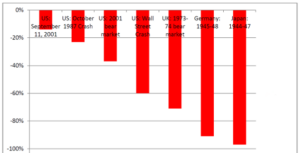
Selected periods of large losses on equities around the world
Source: ‘Triumph of the Optimists’, Elroy Dimson, Paul Marsh, Mike Staunton.
Those declines are in real terms, not merely nominal ones. And to spell out the bad news in all its gory detail, the underlying data are shown below.
US: September 11, 2001: -14%
US: October 1987 Crash: -23%
US: 2001 bear market: -37%
US: Wall Street Crash: -60%
UK: 1973-74 bear market: -71%
Germany: 1945-48: -91%
Japan: 1944-47: -97%.
Dimson, Marsh and Staunton’s conclusions after an exhaustive analysis of investment returns across multiple markets and asset classes were as follows:
“Over the 101 years spanned by our research, stocks have performed better than bonds, but by a narrower margin than was previously surmised. In addition, their returns were enhanced by one-off re-ratings. Taking the evidence of other countries and of a lower prospective equity premium, the apparent superiority of equities will in future years be attenuated. We show that common stocks cannot be regarded as a safe bet for the long haul, even when the investment horizon has a duration of twenty (or more) years.
“First, as we have seen in the opening years of the twenty-first century, investment in equities will remain risky. This is because business itself is risky, and because the years ahead will bring new forms of disorder and volatility..
“Second, if equities remain risky, as must certainly be the case, equity investors should continue to expect a positive risk premium [i.e. be rewarded as compensation for that extra risk].. Nevertheless, we expect that the equity risk premium will turn out to be lower than it has been over the last 101 years..
“Third, we favour holding stocks for the very long run. They are not a guaranteed superior performer over the investment horizon of most investors. They should be held as part of a diversified portfolio, including multiple asset classes from more than one country.. Investors who fail to diversify efficiently and / or who overpay for asset management services can expect to erode their reward for equity risk exposure.” [Emphasis ours.]
A number of highly successful fund managers and investors have emphasised patience as one of the core virtues in investing, often linking it to long-term compounding, waiting for the right opportunities, and resisting short-term market noise, the siren song of “news”, or the urge to overtrade. Among them:
- Warren Buffett, again: “The stock market is a device to transfer money from the impatient to the patient.” Buffett has also said successful investing takes “time, discipline, and patience,” and that “we don’t get paid for activity, just for being right.. we’ll wait indefinitely.
- Buffett’s long term colleague Charlie Munger: “The world is full of foolish gamblers and they will not do as well as the patient investors.” Munger described good investing as requiring “a weird combination of patience and aggression” and noted that “the big money is not in the buying and selling.. but in the waiting.”
- Sir John Templeton: “In order to have a really good investment result, all you need is patience.”
- Nick Sleep (formerly of Nomad Investment Partnership): “Good investing is a minority sport.. and one of the things the crowd is not, is patient.”
- Howard Marks (Oaktree Capital): “Patience is essential.” Marks advocates “patient opportunism – waiting for bargains” and notes that success often comes from being willing to wait for opportunities rather than forcing action.
- Seth Klarman (Baupost Group): Stresses that value investing requires “deep reservoirs of patience and discipline.” Investors need “patience to wait for the right pitch” and that people who lack patience and discipline will lose to those who have them.
- Chuck Akre (Akre Capital Management): “Patience and a long-term perspective are required to give the power of compounding an opportunity to do its magic.”
- Peter Cundill: “Patience, patience and more patience.. it is indispensable.”
This focus on patience appears repeatedly among successful long-term and value-oriented investors. Patience is often framed not as passive waiting but as disciplined restraint: avoiding unnecessary activity, enduring periods of underperformance or inactivity, and acting decisively only when opportunities are attractive. Then simply combine it with a healthy contrarianism.
Fund manager David Iben:
“Human emotions are interesting. We all know to buy low and sell high. But things looks so damn good at the top, and so abysmal at the nadir. Oil, gas, coal, uranium, and hydroelectricity were not competitors at the top, they were all important parts of the solution to a very important question: How are we ever going to meet the insatiable energy needs of 7.3 BILLION people?! Now investors are grappling with how to unload the stigma and potential liability associated with owning archaic relics of a bygone era; so unappealing in the contemporary “post-hydrocarbon” world. People viewed China as a dynamo, a must-own economic juggernaut, destined to leave the United States in the dust. Russia, Brazil, and other economies that are well-endowed with natural resources were accorded royalty status. Along with India, the four were honoured with the sobriquet – BRICs, and were must haves for any trendy portfolio. Now? Not so much. China, Russia, and Brazil are disdained as fraud-ridden, slow-growth, poorly governed producers of oversupplied dreck. Might the markets have moved from one outrageous extreme to the other? We’re sure the truth is somewhere in the middle. At the height of the China hype, the price of ships leapt into the stratosphere only to fall to the lowest level in recorded history of the Baltic Dry index. We live in an era of Fed-induced extremes, and as a result, many valuable “things” can be purchased at all-time low prices.”
To us, there are two conclusions to be drawn from the behaviour of stock markets over the short, medium and longer term. As Dimson, Marsh and Staunton suggest:
- Common stocks cannot be regarded as a safe bet for the long haul. In other words, and especially given the valuation pressures accompanying the monetary policies of QE, ZIRP and NIRP, favour value stocks above all others.
- Stocks should be held as part of a diversified portfolio, including multiple asset classes, not least real assets, including precious metals and commodities, as opposed to unbacked fiat ones, given the existential crisis facing terminally indebted western governments. That is clearly the approach we recommend – and deploy within our own portfolios.
Perhaps a third conclusion is appropriate. Don’t panic ! What seems like bad news is often good news in disguise. As Shelby Davis observed,
“Bear markets make people a lot of money, they just don’t know it at the time.”
………….
As you may know, we also manage bespoke investment portfolios for private clients internationally. We would be delighted to help you too. Because of the current heightened market volatility we are offering a completely free financial review, with no strings attached, to see if our value-oriented approach might benefit your portfolio – with no obligation at all:
Get your Free
financial review
…………
Tim Price is co-manager of the VT Price Value Portfolio and author of ‘Investing through the Looking Glass: a rational guide to irrational financial markets’. You can access a full archive of these weekly investment commentaries here. You can listen to our regular ‘State of the Markets’ podcasts, with Paul Rodriguez of ThinkTrading.com, here. Email us: info@pricevaluepartners.com.
Price Value Partners manage investment portfolios for private clients. We also manage the VT Price Value Portfolio, an unconstrained global fund investing in Benjamin Graham-style value stocks and real assets, and also in systematic trend-following funds. The fund was “Highly commended” in Investment Week’s 2026 Fund Manager of the Year Awards.

“Each year Buffett is asked what’s the main difference between himself and the average investor, and he answers: ‘Patience.’”
Get your Free
financial review
Dow Jones Industrial Average, December 31st 1964 price level: 874.12
Dow Jones Industrial Average, December 31st 1981 price level: 875.00
As Warren Buffett puckishly observed, commenting on this 17 year performance by the broad US stock market,
“Now I’m known as a long-term investor and a patient guy, but that is not my idea of a big move.”
The returns from stock markets are often overstated. As Buffett’s example above makes clear, even the US market, one of the best performing stock markets of the last century, and no slouch during this one, has suffered from long periods in the doldrums. Equity investors are often inadvertently guilty of “survivorship bias”. They tend to focus on the good returns that have arisen from stock markets like those of the US and the UK over the past two centuries. They overlook, or entirely forget, those stock markets that closed down – and which never reopened.
In their magisterial study of long term returns across international markets, ‘Triumph of the optimists’, Elroy Dimson, Paul Marsh and Mike Staunton point out the real winners of the last century. Between 1900 and 2000, for example, the best performing stock market in real terms was not that of the US (annualising at 6.7% real), but Sweden (at 7.6%). Australia was just behind, giving an annualised real return of 7.5%. Then South Africa, at 6.8%. The UK comes in a respectable joint seventh, tied with the Netherlands at an annualised real return of 5.8%. That Australia and South Africa generated the best returns strongly suggests that the 20th Century was a period to own commodity-related stocks.
So much for the very long run. How about those markets, and periods, when investors were distinctly unlucky ?
Selected periods of large losses on equities around the world
Source: ‘Triumph of the Optimists’, Elroy Dimson, Paul Marsh, Mike Staunton.
Those declines are in real terms, not merely nominal ones. And to spell out the bad news in all its gory detail, the underlying data are shown below.
US: September 11, 2001: -14%
US: October 1987 Crash: -23%
US: 2001 bear market: -37%
US: Wall Street Crash: -60%
UK: 1973-74 bear market: -71%
Germany: 1945-48: -91%
Japan: 1944-47: -97%.
Dimson, Marsh and Staunton’s conclusions after an exhaustive analysis of investment returns across multiple markets and asset classes were as follows:
“Over the 101 years spanned by our research, stocks have performed better than bonds, but by a narrower margin than was previously surmised. In addition, their returns were enhanced by one-off re-ratings. Taking the evidence of other countries and of a lower prospective equity premium, the apparent superiority of equities will in future years be attenuated. We show that common stocks cannot be regarded as a safe bet for the long haul, even when the investment horizon has a duration of twenty (or more) years.
“First, as we have seen in the opening years of the twenty-first century, investment in equities will remain risky. This is because business itself is risky, and because the years ahead will bring new forms of disorder and volatility..
“Second, if equities remain risky, as must certainly be the case, equity investors should continue to expect a positive risk premium [i.e. be rewarded as compensation for that extra risk].. Nevertheless, we expect that the equity risk premium will turn out to be lower than it has been over the last 101 years..
“Third, we favour holding stocks for the very long run. They are not a guaranteed superior performer over the investment horizon of most investors. They should be held as part of a diversified portfolio, including multiple asset classes from more than one country.. Investors who fail to diversify efficiently and / or who overpay for asset management services can expect to erode their reward for equity risk exposure.” [Emphasis ours.]
A number of highly successful fund managers and investors have emphasised patience as one of the core virtues in investing, often linking it to long-term compounding, waiting for the right opportunities, and resisting short-term market noise, the siren song of “news”, or the urge to overtrade. Among them:
This focus on patience appears repeatedly among successful long-term and value-oriented investors. Patience is often framed not as passive waiting but as disciplined restraint: avoiding unnecessary activity, enduring periods of underperformance or inactivity, and acting decisively only when opportunities are attractive. Then simply combine it with a healthy contrarianism.
Fund manager David Iben:
“Human emotions are interesting. We all know to buy low and sell high. But things looks so damn good at the top, and so abysmal at the nadir. Oil, gas, coal, uranium, and hydroelectricity were not competitors at the top, they were all important parts of the solution to a very important question: How are we ever going to meet the insatiable energy needs of 7.3 BILLION people?! Now investors are grappling with how to unload the stigma and potential liability associated with owning archaic relics of a bygone era; so unappealing in the contemporary “post-hydrocarbon” world. People viewed China as a dynamo, a must-own economic juggernaut, destined to leave the United States in the dust. Russia, Brazil, and other economies that are well-endowed with natural resources were accorded royalty status. Along with India, the four were honoured with the sobriquet – BRICs, and were must haves for any trendy portfolio. Now? Not so much. China, Russia, and Brazil are disdained as fraud-ridden, slow-growth, poorly governed producers of oversupplied dreck. Might the markets have moved from one outrageous extreme to the other? We’re sure the truth is somewhere in the middle. At the height of the China hype, the price of ships leapt into the stratosphere only to fall to the lowest level in recorded history of the Baltic Dry index. We live in an era of Fed-induced extremes, and as a result, many valuable “things” can be purchased at all-time low prices.”
To us, there are two conclusions to be drawn from the behaviour of stock markets over the short, medium and longer term. As Dimson, Marsh and Staunton suggest:
Perhaps a third conclusion is appropriate. Don’t panic ! What seems like bad news is often good news in disguise. As Shelby Davis observed,
“Bear markets make people a lot of money, they just don’t know it at the time.”
………….
As you may know, we also manage bespoke investment portfolios for private clients internationally. We would be delighted to help you too. Because of the current heightened market volatility we are offering a completely free financial review, with no strings attached, to see if our value-oriented approach might benefit your portfolio – with no obligation at all:
Get your Free
financial review
…………
Tim Price is co-manager of the VT Price Value Portfolio and author of ‘Investing through the Looking Glass: a rational guide to irrational financial markets’. You can access a full archive of these weekly investment commentaries here. You can listen to our regular ‘State of the Markets’ podcasts, with Paul Rodriguez of ThinkTrading.com, here. Email us: info@pricevaluepartners.com.
Price Value Partners manage investment portfolios for private clients. We also manage the VT Price Value Portfolio, an unconstrained global fund investing in Benjamin Graham-style value stocks and real assets, and also in systematic trend-following funds. The fund was “Highly commended” in Investment Week’s 2026 Fund Manager of the Year Awards.
Take a closer look
Take a look at the data of our investments and see what makes us different.
LOOK CLOSERSubscribe
Sign up for the latest news on investments and market insights.
KEEP IN TOUCHContact us
In order to find out more about PVP please get in touch with our team.
CONTACT USTim Price