“A wealth of information creates a poverty of attention.”
Get your Free
financial review
In February 2010, US helicopters launched an attack on a convoy of vehicles in Afghanistan. The targets were not terrorists; they turned out to be innocent Afghan civilians. In all, 23 villagers, including children, were killed. It was one of the worst instances of civilian losses of the war. The US air force and army were hardly lacking resources, including state-of-the-art surveillance technology. So how did this tragedy happen ?
Two words: information overload. The operator of a Predator drone had failed to pass along vital information about the composition of a growing crowd of villagers, including the fact that a number of children were among them. The drone operator and his team, working remotely from an air force base in Nevada, were struggling to work out what was happening in the village where the convoy was forming. One of the reasons for their confusion was that while they were monitoring the video feeds from the drone, they were also engaged in dozens of instant-message and radio conversations with intelligence analysts along with troops on the ground.
One military official, speaking on condition of anonymity, admitted:
“Information overload – an accurate description.”
The civilian deaths could have been avoided “if we had just slowed things down and thought deliberately.”
Nor was the 2010 accident a one-off. In tests, researchers discovered that when soldiers operate a tank while monitoring remote video feeds, they often fail to see targets right in front of them.
Multitasking is widely misunderstood. Earl Miller, a neuroscientist at MIT, and an expert on what is called “divided attention”, points out that our brains are
“not wired to multitask well.. When people think they’re multitasking, they’re actually just switching from one task to another very rapidly. And every time they do, there’s a cognitive cost in doing so.”
Multitasking may actually be making us less efficient.
Neuroscientist Daniel Levitin observes that multitasking has been found to increase the stress hormone cortisol as well as the fight-or-flight hormone adrenaline, which ends up overstimulating the brain and causing a sort of mental fog.
“Multitasking creates a dopamine-addiction feedback loop, effectively rewarding the brain for losing focus and for constantly searching for external stimulation. To make matters worse, the prefrontal cortex has a novelty bias, meaning that its attention can be easily hijacked by something new – the proverbial shiny objects we use to entice infants, puppies, and kittens. The irony here for those of us who are trying to focus amid competing activities is clear: the very brain region we need to rely on for staying on task is easily distracted. We answer the phone, look up something on the internet, check our email, send an SMS, and each of these things tweaks the novelty- seeking, reward-seeking centres of the brain, causing a burst of endogenous opioids (no wonder it feels so good!), all to the detriment of our staying on task. It is the ultimate empty-caloried brain candy. Instead of reaping the big rewards that come from sustained, focused effort, we instead reap empty rewards from completing a thousand little sugar-coated tasks.”
And multitasking is no respecter of office, or rank.
During the BP oil well blow-up in the Gulf of Mexico, Coast Guard Admiral Thad Allen, the incident commander, estimates that he received 300 to 400 pages of emails, texts, reports, and other forms of message, every day. Allen confessed that this Niagara of data may have contributed to what he calls the mistake of failing to close off air space above the Gulf on day one of the disaster. (There were eight near mid-air collisions.)
Of course we don’t all face the responsibility of making life or death decisions while tackling this glut of information. But the information glut remains.
Neuroscientist Daniel Levitin again:
“Our brains are busier than ever before. We’re assaulted with facts, pseudo facts, jibber-jabber, and rumour, all posing as information. Trying to figure out what you need to know and what you can ignore is exhausting. At the same time, we are all doing more. Thirty years ago, travel agents made our airline and rail reservations, salespeople helped us find what we were looking for in shops, and professional typists or secretaries helped busy people with their correspondence. Now we do most of those things ourselves. We are doing the jobs of 10 different people while still trying to keep up with our lives, our children and parents, our friends, our careers, our hobbies, and our favourite TV shows.”
The problem has been christened in numerous ways: “data asphyxiation” (William van Winkle); “data smog” (David Shenk); “information fatigue syndrome” (David Lewis); “cognitive overload” (Eric Schmidt); “time famine” (Leslie Perlow). But they all amount to broadly the same thing. We are all drowning in information.
The psychologist David Lewis points out that in the modern world, having too much information can be as dangerous as having too little:
“..information overload can lead to a paralysis of analysis, making it far harder to find the right solutions or make the best decisions.”
A survey by Reuters found that two-thirds of managers believe that the information glut has made their jobs less satisfying or hurt their personal relationships. One-third believe it has damaged their health. Another survey suggests that most managers think that most of the information they receive is useless.
Take something as apparently simple as shopping.
Barry Schwartz, author of ‘The paradox of choice’, uses the example of his local supermarket. It stocks 85 different varieties and brands of crackers. Next to the crackers are 285 varieties of cookies. Among just chocolate chip cookies there are 21 different choices. There are 75 different types of iced teas and adult drinks. In the snack aisle, there are 95 different options in total, in terms of crisps (taco and potato, ridged and flat, flavoured and unflavoured, salted and unsalted, high fat, low fat and no fat), and a dozen varieties of Pringles. There are also 61 varieties of suntan lotion, 40 options for toothpaste, and 360 types of shampoo.
It’s overwhelming. Faced with this over-abundance of choice, some shoppers make an entirely rational decision – and, despairing at all this choice, choose to buy nothing at all.
The same problem arises in investment. The Investment Association in the UK tracks around 4,800 funds. (We manage one – and only one – of them. Its recent performance is shown below.)
VT Price Value Portfolio A GBP share class – 2021 to 2026
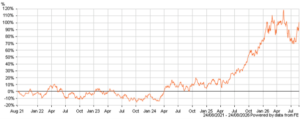
Source: Hargreaves Lansdown
Those 4,800 funds comprise a universe three times larger than the 1,500 companies listed in London.
Then factor in other investment choices, such as government bonds, corporate bonds, currencies and derivatives, and the investment universe available to the average investor is as close to infinite as makes no practical difference.
Then there are the sources of information and commentary, not to mention constantly changing prices, swirling out from that universe of investments. ‘Analysis paralysis’ is an entirely understandable response.
So how do we keep our heads above water ?
There are two parts to the investment process: the asset allocation split (which is almost certainly the single most important investment decision you will make with your money), and then the underlying composition of each of those asset pots – the specific investments themselves.
A good deal of research tends to support the thesis that asset allocation – how you divide your capital between different asset classes – will have more bearing on portfolio returns than any other single investment choice. But the asset class universe itself is clearly important: if you’re only considering allocations to stocks and bonds, say, you’re not being sufficiently diversified, in our opinion. And if stock and bond markets were to closely correlate in a bear market (i.e. fall together), the benefits of diversification will look pretty meagre.
And asset allocation is not just about maximising investment returns. If this were the case, then the default position for most investors would be to have 100% of their portfolio committed to the stock market. Two centuries’ worth of data from the US and UK stock markets provides plausible evidence that the long run average annual real (i.e. after inflation) return from stocks stands at between 6 and 7 percent.
The problem is that those figures relate to a very long term time period. That somewhat mythical 6 to 7 percent figure hardly ever materialises in any given year. Stock market returns are lumpy – more like discrete annual returns of +5%, -10%, +16%, and so on.
It’s also worth bearing in mind one of the most important observations in investment. Starting valuations matter. The most important driver of investment returns for any given investment you make is what price you pay for it when you buy it. Almost irrespective of quality, if you can buy an asset at a cheap enough price, you will almost certainly thrive over the medium term. If you pay over the odds for the same asset, you are likely to do poorly.
So it pays to be discriminating.
And it’s clearly worth acknowledging the unusual state of the current financial environment. Years of easy money and artificially suppressed interest rates have seriously distorted the prices of most financial assets.
No discussion of asset allocation would be complete without a candid assessment of one’s risk appetite. Like many investors we’re risk averse – we try as best we can to avoid the permanent loss of capital. Within a multi-asset portfolio, not all investments will necessarily rise, or fall, at the same time, but our primary objective is to avoid the risk of ruin at all costs. So our investment objective is to try and generate meaningful absolute returns (as opposed to aggressive returns relative to the stock market, for example). So in this context, the appropriate benchmark or reference rate is not some measure of stock market performance, such as the FTSE 100 or the MSCI World Equity Index, but rather something closer to a notionally risk-free rate such as cash, or inflation.
So, to address each of those asset allocations in turn.
Why hold cash when it earns next to nothing in the bank ? For one reason, because it gives us optionality – the flexibility to buy into the market at a future date at what might be dramatically lower levels than today’s. For another reason, out of a wearied acceptance that so many other types of asset seem unreasonably expensive.
Next: bonds. The longer Scott Bessent (and Andy Burnham) stays in office, the more uninvestable bonds become.
Within a multi-asset portfolio there’s always room for ‘absolute return’ funds. We favour systematic trend-following strategies.
Which brings us to what is perhaps the most intriguing and attractive segment of our portfolio, namely hard, real assets: gold and silver, and commodities companies more generally. Longstanding readers will appreciate that this allocation is driven by genuine concern about the stability and sanctity of our monetary system.
The gold market has been bifurcated for several years now. The ‘paper’ market (i.e. gold futures) has traded somewhat erratically since its recent high in fiat terms. But the underlying bullion market has seen a constant stream of physical gold heading from the west towards Asia. We very much doubt whether that gold will ever return. Given the extent to which ‘paper’ gold contracts have been issued relative to the underlying supply of the real, physical asset, when the music stops, at some point there is likely to be a scramble to secure physical bullion. Since the timing of such events is not forecastable, we don’t want to be short gold, and we’re willing to be patient with these exposures.
So one way of dealing with the oversupply of investment choices – extreme selectivity – largely resolves the problem of information overload all by itself. By focusing only on a tightly defined universe of assets combining inherent quality with fundamental underlying ‘value’ (itself a function of price), most investment choices naturally then fall away because they can’t meet either characteristic, let alone both of them. So our universe of potential interest naturally contracts to an altogether more easily addressable size.
Then there’s dealing with the risk of information overload in the form of newsflow. Unless you’re a day trader, there’s simply no need to position yourself in front of a screen and expose yourself to a constant stream of changing prices and news feeds, all of which will encourage you to (over)trade. So don’t just prioritize by way of investment attributes. Prioritize by way of information sources. The problem with the Internet is that it’s an always-on medium that offers up, to all intents and purposes, an infinite variety of stimulus.
So one answer is technological. In the words of ‘The Economist’ magazine, “rely on the people who created the fog to invent filters that will clear it up”.
A second answer involves willpower. “Ration your intake. Turn off your mobile phone and Internet from time to time.”
Business leaders have also weighed in.
David Novak of Yum ! Brands advises people to ask themselves whether what they are doing is constructive or a mere “activity”. (The Internet may be the biggest distraction device in history.)
The venture capitalist John Doerr urges people to focus on a narrow range of objectives and to filter out everything else. (Easier said than done.)
Cristobal Conde of the IT firm SunGard sets aside “thinking time” in his schedule, when he doesn’t allow himself to be disturbed.
So if in doubt, switch off.
And remember Warren Buffett’s sage advice about the punch-card:
“I could improve your ultimate financial welfare by giving you a ticket with only twenty slots in it so that you had twenty punches – representing all the investments that you got to make in a lifetime. And once you’d punched through the card, you couldn’t make any more investments at all. Under those rules, you’d really think carefully about what you did, and you’d be forced to load up on what you’d really thought about. So you’d do so much better.”
………….
As you may know, we also manage bespoke investment portfolios for private clients internationally. We would be delighted to help you too. Because of the current heightened market volatility we are offering a completely free financial review, with no strings attached, to see if our value-oriented approach might benefit your portfolio – with no obligation at all:
Get your Free
financial review
…………
Tim Price is co-manager of the VT Price Value Portfolio and author of ‘Investing through the Looking Glass: a rational guide to irrational financial markets’. You can access a full archive of these weekly investment commentaries here. You can listen to our regular ‘State of the Markets’ podcasts, with Paul Rodriguez of ThinkTrading.com, here. Email us: info@pricevaluepartners.com.
Price Value Partners manage investment portfolios for private clients. We also manage the VT Price Value Portfolio, an unconstrained global fund investing in Benjamin Graham-style value stocks and real assets, and also in systematic trend-following funds. The fund was “Highly commended” in Investment Week’s 2026 Fund Manager of the Year Awards.

“A wealth of information creates a poverty of attention.”
Get your Free
financial review
In February 2010, US helicopters launched an attack on a convoy of vehicles in Afghanistan. The targets were not terrorists; they turned out to be innocent Afghan civilians. In all, 23 villagers, including children, were killed. It was one of the worst instances of civilian losses of the war. The US air force and army were hardly lacking resources, including state-of-the-art surveillance technology. So how did this tragedy happen ?
Two words: information overload. The operator of a Predator drone had failed to pass along vital information about the composition of a growing crowd of villagers, including the fact that a number of children were among them. The drone operator and his team, working remotely from an air force base in Nevada, were struggling to work out what was happening in the village where the convoy was forming. One of the reasons for their confusion was that while they were monitoring the video feeds from the drone, they were also engaged in dozens of instant-message and radio conversations with intelligence analysts along with troops on the ground.
One military official, speaking on condition of anonymity, admitted:
“Information overload – an accurate description.”
The civilian deaths could have been avoided “if we had just slowed things down and thought deliberately.”
Nor was the 2010 accident a one-off. In tests, researchers discovered that when soldiers operate a tank while monitoring remote video feeds, they often fail to see targets right in front of them.
Multitasking is widely misunderstood. Earl Miller, a neuroscientist at MIT, and an expert on what is called “divided attention”, points out that our brains are
“not wired to multitask well.. When people think they’re multitasking, they’re actually just switching from one task to another very rapidly. And every time they do, there’s a cognitive cost in doing so.”
Multitasking may actually be making us less efficient.
Neuroscientist Daniel Levitin observes that multitasking has been found to increase the stress hormone cortisol as well as the fight-or-flight hormone adrenaline, which ends up overstimulating the brain and causing a sort of mental fog.
“Multitasking creates a dopamine-addiction feedback loop, effectively rewarding the brain for losing focus and for constantly searching for external stimulation. To make matters worse, the prefrontal cortex has a novelty bias, meaning that its attention can be easily hijacked by something new – the proverbial shiny objects we use to entice infants, puppies, and kittens. The irony here for those of us who are trying to focus amid competing activities is clear: the very brain region we need to rely on for staying on task is easily distracted. We answer the phone, look up something on the internet, check our email, send an SMS, and each of these things tweaks the novelty- seeking, reward-seeking centres of the brain, causing a burst of endogenous opioids (no wonder it feels so good!), all to the detriment of our staying on task. It is the ultimate empty-caloried brain candy. Instead of reaping the big rewards that come from sustained, focused effort, we instead reap empty rewards from completing a thousand little sugar-coated tasks.”
And multitasking is no respecter of office, or rank.
During the BP oil well blow-up in the Gulf of Mexico, Coast Guard Admiral Thad Allen, the incident commander, estimates that he received 300 to 400 pages of emails, texts, reports, and other forms of message, every day. Allen confessed that this Niagara of data may have contributed to what he calls the mistake of failing to close off air space above the Gulf on day one of the disaster. (There were eight near mid-air collisions.)
Of course we don’t all face the responsibility of making life or death decisions while tackling this glut of information. But the information glut remains.
Neuroscientist Daniel Levitin again:
“Our brains are busier than ever before. We’re assaulted with facts, pseudo facts, jibber-jabber, and rumour, all posing as information. Trying to figure out what you need to know and what you can ignore is exhausting. At the same time, we are all doing more. Thirty years ago, travel agents made our airline and rail reservations, salespeople helped us find what we were looking for in shops, and professional typists or secretaries helped busy people with their correspondence. Now we do most of those things ourselves. We are doing the jobs of 10 different people while still trying to keep up with our lives, our children and parents, our friends, our careers, our hobbies, and our favourite TV shows.”
The problem has been christened in numerous ways: “data asphyxiation” (William van Winkle); “data smog” (David Shenk); “information fatigue syndrome” (David Lewis); “cognitive overload” (Eric Schmidt); “time famine” (Leslie Perlow). But they all amount to broadly the same thing. We are all drowning in information.
The psychologist David Lewis points out that in the modern world, having too much information can be as dangerous as having too little:
“..information overload can lead to a paralysis of analysis, making it far harder to find the right solutions or make the best decisions.”
A survey by Reuters found that two-thirds of managers believe that the information glut has made their jobs less satisfying or hurt their personal relationships. One-third believe it has damaged their health. Another survey suggests that most managers think that most of the information they receive is useless.
Take something as apparently simple as shopping.
Barry Schwartz, author of ‘The paradox of choice’, uses the example of his local supermarket. It stocks 85 different varieties and brands of crackers. Next to the crackers are 285 varieties of cookies. Among just chocolate chip cookies there are 21 different choices. There are 75 different types of iced teas and adult drinks. In the snack aisle, there are 95 different options in total, in terms of crisps (taco and potato, ridged and flat, flavoured and unflavoured, salted and unsalted, high fat, low fat and no fat), and a dozen varieties of Pringles. There are also 61 varieties of suntan lotion, 40 options for toothpaste, and 360 types of shampoo.
It’s overwhelming. Faced with this over-abundance of choice, some shoppers make an entirely rational decision – and, despairing at all this choice, choose to buy nothing at all.
The same problem arises in investment. The Investment Association in the UK tracks around 4,800 funds. (We manage one – and only one – of them. Its recent performance is shown below.)
VT Price Value Portfolio A GBP share class – 2021 to 2026
Source: Hargreaves Lansdown
Those 4,800 funds comprise a universe three times larger than the 1,500 companies listed in London.
Then factor in other investment choices, such as government bonds, corporate bonds, currencies and derivatives, and the investment universe available to the average investor is as close to infinite as makes no practical difference.
Then there are the sources of information and commentary, not to mention constantly changing prices, swirling out from that universe of investments. ‘Analysis paralysis’ is an entirely understandable response.
So how do we keep our heads above water ?
There are two parts to the investment process: the asset allocation split (which is almost certainly the single most important investment decision you will make with your money), and then the underlying composition of each of those asset pots – the specific investments themselves.
A good deal of research tends to support the thesis that asset allocation – how you divide your capital between different asset classes – will have more bearing on portfolio returns than any other single investment choice. But the asset class universe itself is clearly important: if you’re only considering allocations to stocks and bonds, say, you’re not being sufficiently diversified, in our opinion. And if stock and bond markets were to closely correlate in a bear market (i.e. fall together), the benefits of diversification will look pretty meagre.
And asset allocation is not just about maximising investment returns. If this were the case, then the default position for most investors would be to have 100% of their portfolio committed to the stock market. Two centuries’ worth of data from the US and UK stock markets provides plausible evidence that the long run average annual real (i.e. after inflation) return from stocks stands at between 6 and 7 percent.
The problem is that those figures relate to a very long term time period. That somewhat mythical 6 to 7 percent figure hardly ever materialises in any given year. Stock market returns are lumpy – more like discrete annual returns of +5%, -10%, +16%, and so on.
It’s also worth bearing in mind one of the most important observations in investment. Starting valuations matter. The most important driver of investment returns for any given investment you make is what price you pay for it when you buy it. Almost irrespective of quality, if you can buy an asset at a cheap enough price, you will almost certainly thrive over the medium term. If you pay over the odds for the same asset, you are likely to do poorly.
So it pays to be discriminating.
And it’s clearly worth acknowledging the unusual state of the current financial environment. Years of easy money and artificially suppressed interest rates have seriously distorted the prices of most financial assets.
No discussion of asset allocation would be complete without a candid assessment of one’s risk appetite. Like many investors we’re risk averse – we try as best we can to avoid the permanent loss of capital. Within a multi-asset portfolio, not all investments will necessarily rise, or fall, at the same time, but our primary objective is to avoid the risk of ruin at all costs. So our investment objective is to try and generate meaningful absolute returns (as opposed to aggressive returns relative to the stock market, for example). So in this context, the appropriate benchmark or reference rate is not some measure of stock market performance, such as the FTSE 100 or the MSCI World Equity Index, but rather something closer to a notionally risk-free rate such as cash, or inflation.
So, to address each of those asset allocations in turn.
Why hold cash when it earns next to nothing in the bank ? For one reason, because it gives us optionality – the flexibility to buy into the market at a future date at what might be dramatically lower levels than today’s. For another reason, out of a wearied acceptance that so many other types of asset seem unreasonably expensive.
Next: bonds. The longer Scott Bessent (and Andy Burnham) stays in office, the more uninvestable bonds become.
Within a multi-asset portfolio there’s always room for ‘absolute return’ funds. We favour systematic trend-following strategies.
Which brings us to what is perhaps the most intriguing and attractive segment of our portfolio, namely hard, real assets: gold and silver, and commodities companies more generally. Longstanding readers will appreciate that this allocation is driven by genuine concern about the stability and sanctity of our monetary system.
The gold market has been bifurcated for several years now. The ‘paper’ market (i.e. gold futures) has traded somewhat erratically since its recent high in fiat terms. But the underlying bullion market has seen a constant stream of physical gold heading from the west towards Asia. We very much doubt whether that gold will ever return. Given the extent to which ‘paper’ gold contracts have been issued relative to the underlying supply of the real, physical asset, when the music stops, at some point there is likely to be a scramble to secure physical bullion. Since the timing of such events is not forecastable, we don’t want to be short gold, and we’re willing to be patient with these exposures.
So one way of dealing with the oversupply of investment choices – extreme selectivity – largely resolves the problem of information overload all by itself. By focusing only on a tightly defined universe of assets combining inherent quality with fundamental underlying ‘value’ (itself a function of price), most investment choices naturally then fall away because they can’t meet either characteristic, let alone both of them. So our universe of potential interest naturally contracts to an altogether more easily addressable size.
Then there’s dealing with the risk of information overload in the form of newsflow. Unless you’re a day trader, there’s simply no need to position yourself in front of a screen and expose yourself to a constant stream of changing prices and news feeds, all of which will encourage you to (over)trade. So don’t just prioritize by way of investment attributes. Prioritize by way of information sources. The problem with the Internet is that it’s an always-on medium that offers up, to all intents and purposes, an infinite variety of stimulus.
So one answer is technological. In the words of ‘The Economist’ magazine, “rely on the people who created the fog to invent filters that will clear it up”.
A second answer involves willpower. “Ration your intake. Turn off your mobile phone and Internet from time to time.”
Business leaders have also weighed in.
David Novak of Yum ! Brands advises people to ask themselves whether what they are doing is constructive or a mere “activity”. (The Internet may be the biggest distraction device in history.)
The venture capitalist John Doerr urges people to focus on a narrow range of objectives and to filter out everything else. (Easier said than done.)
Cristobal Conde of the IT firm SunGard sets aside “thinking time” in his schedule, when he doesn’t allow himself to be disturbed.
So if in doubt, switch off.
And remember Warren Buffett’s sage advice about the punch-card:
“I could improve your ultimate financial welfare by giving you a ticket with only twenty slots in it so that you had twenty punches – representing all the investments that you got to make in a lifetime. And once you’d punched through the card, you couldn’t make any more investments at all. Under those rules, you’d really think carefully about what you did, and you’d be forced to load up on what you’d really thought about. So you’d do so much better.”
………….
As you may know, we also manage bespoke investment portfolios for private clients internationally. We would be delighted to help you too. Because of the current heightened market volatility we are offering a completely free financial review, with no strings attached, to see if our value-oriented approach might benefit your portfolio – with no obligation at all:
Get your Free
financial review
…………
Tim Price is co-manager of the VT Price Value Portfolio and author of ‘Investing through the Looking Glass: a rational guide to irrational financial markets’. You can access a full archive of these weekly investment commentaries here. You can listen to our regular ‘State of the Markets’ podcasts, with Paul Rodriguez of ThinkTrading.com, here. Email us: info@pricevaluepartners.com.
Price Value Partners manage investment portfolios for private clients. We also manage the VT Price Value Portfolio, an unconstrained global fund investing in Benjamin Graham-style value stocks and real assets, and also in systematic trend-following funds. The fund was “Highly commended” in Investment Week’s 2026 Fund Manager of the Year Awards.
Take a closer look
Take a look at the data of our investments and see what makes us different.
LOOK CLOSERSubscribe
Sign up for the latest news on investments and market insights.
KEEP IN TOUCHContact us
In order to find out more about PVP please get in touch with our team.
CONTACT USTim Price