“Gentlemen, you can’t fight in here ! This is the War Room !”
- President Merkin Muffley (Peter Sellers), ‘Dr. Strangelove or: How I learned to stop worrying and love the bomb’, 1964, dir. Stanley Kubrick.
Get your Free
financial review
The following few paragraphs are extracted from our 2015 book ‘The War On Cash’ which you can download for free here.
On 17 April 1961, a brigade of 1,400 Cuban exiles with the support of the United States Navy, the US Air Force and the CIA, invaded the swampy coast of Cuba at the Bay of Pigs. Their goal was to overthrow Castro. But nothing went as planned. Four ships were supposed to supply them with ammunition and supplies, but not one of them arrived. Two of them were sunk by the Cuban Air Force and the other two fled.
On the second day, the brigade was completely surrounded by 20,000 Cuban soldiers. By the third day, almost all of the insurgents that hadn’t been killed were captured and led off to prison camps.
In his book ‘Groupthink: psychological studies of policy decisions and fiascos’, the psychologist Irving L. Janis writes that the Bay of Pigs plan “ranks among the worst fiascos ever perpetrated by a responsible government… all the major assumptions supporting the plan were so completely wrong that the venture began to founder at the outset and failed in its earliest stages”.
How did such a disaster happen? There was no doubt about the technical qualifications of President Kennedy’s policy team that dreamt up the plan. Dean Rusk, Secretary of State, had been recruited by the President himself from acting head of the Rockefeller Foundation. Robert McNamara, the Secretary of Defence, was an expert statistician who had worked his way up the presidency of the Ford Motor Company. The President’s brother, Bobby, the Attorney General, was one of the most influential members of the team. McGeorge Bundy, Arthur Schlesinger, Jr. and Richard Goodwin, were Harvard men of impeccable reputation.
Janis points to six major miscalculations made by the President’s team. The first was that the invasion would never be traced back to the US government. The second was that the Cuban air force could be knocked out completely before the invasion began. The third was that the 1,400 men would be willing to carry out the invasion without any help from US ground troops. The fourth was that Castro’s army was too weak to counter the insurgents. The fifth was that the invasion would trigger support by the Cuban underground and set off armed uprisings that would topple Castro himself (sound familiar?). The sixth was that if the brigade did fail in its primary objective, the men could retreat to the mountains and reinforce anti-Castro guerrilla units. Each assumption was proven wrong.
Groupthink is the means by which humans make their worst mistakes. Because when power is concentrated among a small group their mistakes are bigger and more costly. When power is diffused across the population no one bad decision can lead to disaster.
Janis also identifies the traits common to all groupthink. The group’s discussions are often limited to a handful of alternatives – there is insufficient choice. The group fails to survey the objectives of the task and the values implied by the favoured plan. The group fails to re-examine the consensus choice in the context of risks and drawbacks never initially considered. And the group neglects courses of action initially considered unsatisfactory. They spend almost no time discussing whether they have overlooked anything. And members of the group make little or no attempt to obtain information from outside experts. Members of the group also disregard information from outside the group. And they spend little or no time considering how the chosen policy might be hindered by bureaucratic inertia, thrown off course by political opponents or derailed by accidents. So they don’t make contingency plans that could help them cope with any setbacks.
Beating groupthink boils down to some common sense principles. Nobody is perfect, for example – easy to say, but difficult for a robust group, confident in its own ability, to accept in practice. And the decisions made by groups can be particularly imperfect. The more cohesive the group, the more resistant it becomes to external criticism.
In addition to the Bay of Pigs fiasco, Janis studied in depth four other American policy disasters: Pearl Harbour; Truman’s invasion of North Korea; Johnson’s escalation of the Vietnam War, and Nixon’s cover-up of the Watergate scandal. He found that groupthink played a critical role in every one.
JFK learnt from his Cuban misadventures. When he subsequently held Cabinet meetings, he would frame the issue at hand and invite comments from those assembled. Only once everyone had expressed an opinion would he then weigh in and offer his own judgment. Perhaps someone within the MAGA movement could buy President Trump a copy of Janis’ excellent book.
Speaking of massive geopolitical mistakes brings us to the current situation in Iran. The Middle East has done for multiple political reputations. Take, for example, the Suez crisis. What follows is a lightly edited summary via Grok.
The Suez Canal — opened in 1869 — remains one of the world’s most important shipping routes, connecting the Mediterranean Sea to the Red Sea and drastically shortening the journey between Europe and Asia. It carried roughly two-thirds of Europe’s oil supply at the time. The canal was owned and operated by the Suez Canal Company, a private firm controlled by British and French shareholders.
Egypt (under British influence for decades) experienced growing nationalist sentiment after the 1952 revolution that brought Colonel Gamal Abdel Nasser to power.
In mid-1956, the US and UK withdrew promised funding for Egypt’s massive Aswan High Dam project (partly because of Nasser’s growing ties to the Soviet bloc, including an arms deal with Czechoslovakia).
On July 26, 1956, Nasser responded by nationalizing the Suez Canal Company, intending to use the canal’s toll revenues to fund the dam and assert Egyptian sovereignty.
This move outraged Britain and France (who saw it as a direct threat to their economic interests and prestige) and alarmed Israel (which faced an Egyptian blockade of the Straits of Tiran, blocking Israeli shipping access to the Red Sea, plus fedayeen raids supported by Egypt).
Britain, France, and Israel secretly colluded in a plan (often called the Sèvres Protocol). On October 29, 1956, Israel launched a large-scale invasion of Egypt’s Sinai Peninsula, rapidly advancing toward the canal. Their stated goals included opening the Straits of Tiran and weakening Egyptian forces.
October 30–31, 1956 — Britain and France issued a pre-arranged ultimatum demanding both Israel and Egypt withdraw 10 miles from the canal — knowing Egypt would refuse.
When Egypt rejected it, Britain and France began aerial bombing of Egyptian targets (October 31) and then landed paratroopers and troops along the canal starting November 5, claiming they were “separating the combatants” and protecting the waterway.
The military campaign was quick and initially successful: Israeli forces crushed Egyptian defenses in Sinai, and Anglo-French troops seized parts of the canal zone.
The plan backfired spectacularly due to massive international pressure. The United States (under President Eisenhower) strongly opposed the action — partly on principle (anti-colonialism), partly because it distracted from the simultaneous Soviet invasion of Hungary, and partly because it feared pushing Arab states toward the USSR.
The Soviet Union threatened rocket attacks on Britain, France, and even Israel.
Massive financial pressure (especially the US threatening to withhold support for the British pound) and condemnation at the United Nations forced a ceasefire.
By November 6–7, 1956, a ceasefire took effect. British and French forces withdrew by late December 1956; Israeli forces pulled out of Sinai and Gaza by March 1957 (under US pressure). A new United Nations Emergency Force (UNEF) — the first major UN peacekeeping mission — was deployed to supervise the border.
Egypt under Nasser was militarily defeated but emerged as a huge political victor. Nasser became a hero of Arab nationalism and anti-colonialism across the developing world.
Britain and France suffered deep humiliation. It marked the effective end of their status as independent great powers in the Middle East and accelerated decolonization (e.g., Britain’s influence collapsed rapidly afterward).
Israel achieved temporary gains (open Straits of Tiran until 1967) but had to withdraw from captured territory.
In short, the Suez Crisis was about control of a vital global trade artery, wounded imperial pride, Arab nationalism, and Cold War manoeuvring — and it dramatically accelerated the shift toward a post-colonial world order.
As Professor John MearScheimer has pointed out, it is naïve for a sports team to arrive on the field with their strategy and tactics planned, but to assume that their opponents won’t have their own response. The US-Israeli attack on Iran smacks of groupthink. The economic consequences from an extended conflict will be for the rest of the world to find out.
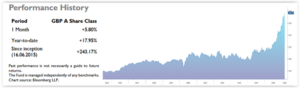
And so an ever more farcical 1970s geopolitical tribute act rolls giddily on. This is how unsustainable monetary systems finally die: first with a bang, then with a whimper. How are we positioned ? Readers can read more about our positioning here. As at end February 2026, the performance of our fund since inception in June 2015 is shown below.
………….
As you may know, we also manage bespoke investment portfolios for private clients internationally. We would be delighted to help you too. Because of the current heightened market volatility we are offering a completely free financial review, with no strings attached, to see if our value-oriented approach might benefit your portfolio – with no obligation at all:
Get your Free
financial review
…………
Tim Price is co-manager of the VT Price Value Portfolio and author of ‘Investing through the Looking Glass: a rational guide to irrational financial markets’. You can access a full archive of these weekly investment commentaries here. You can listen to our regular ‘State of the Markets’ podcasts, with Paul Rodriguez of ThinkTrading.com, here. Email us: info@pricevaluepartners.com.
Price Value Partners manage investment portfolios for private clients. We also manage the VT Price Value Portfolio, an unconstrained global fund investing in Benjamin Graham-style value stocks and real assets, and also in systematic trend-following funds.

“Gentlemen, you can’t fight in here ! This is the War Room !”
Get your Free
financial review
The following few paragraphs are extracted from our 2015 book ‘The War On Cash’ which you can download for free here.
On 17 April 1961, a brigade of 1,400 Cuban exiles with the support of the United States Navy, the US Air Force and the CIA, invaded the swampy coast of Cuba at the Bay of Pigs. Their goal was to overthrow Castro. But nothing went as planned. Four ships were supposed to supply them with ammunition and supplies, but not one of them arrived. Two of them were sunk by the Cuban Air Force and the other two fled.
On the second day, the brigade was completely surrounded by 20,000 Cuban soldiers. By the third day, almost all of the insurgents that hadn’t been killed were captured and led off to prison camps.
In his book ‘Groupthink: psychological studies of policy decisions and fiascos’, the psychologist Irving L. Janis writes that the Bay of Pigs plan “ranks among the worst fiascos ever perpetrated by a responsible government… all the major assumptions supporting the plan were so completely wrong that the venture began to founder at the outset and failed in its earliest stages”.
How did such a disaster happen? There was no doubt about the technical qualifications of President Kennedy’s policy team that dreamt up the plan. Dean Rusk, Secretary of State, had been recruited by the President himself from acting head of the Rockefeller Foundation. Robert McNamara, the Secretary of Defence, was an expert statistician who had worked his way up the presidency of the Ford Motor Company. The President’s brother, Bobby, the Attorney General, was one of the most influential members of the team. McGeorge Bundy, Arthur Schlesinger, Jr. and Richard Goodwin, were Harvard men of impeccable reputation.
Janis points to six major miscalculations made by the President’s team. The first was that the invasion would never be traced back to the US government. The second was that the Cuban air force could be knocked out completely before the invasion began. The third was that the 1,400 men would be willing to carry out the invasion without any help from US ground troops. The fourth was that Castro’s army was too weak to counter the insurgents. The fifth was that the invasion would trigger support by the Cuban underground and set off armed uprisings that would topple Castro himself (sound familiar?). The sixth was that if the brigade did fail in its primary objective, the men could retreat to the mountains and reinforce anti-Castro guerrilla units. Each assumption was proven wrong.
Groupthink is the means by which humans make their worst mistakes. Because when power is concentrated among a small group their mistakes are bigger and more costly. When power is diffused across the population no one bad decision can lead to disaster.
Janis also identifies the traits common to all groupthink. The group’s discussions are often limited to a handful of alternatives – there is insufficient choice. The group fails to survey the objectives of the task and the values implied by the favoured plan. The group fails to re-examine the consensus choice in the context of risks and drawbacks never initially considered. And the group neglects courses of action initially considered unsatisfactory. They spend almost no time discussing whether they have overlooked anything. And members of the group make little or no attempt to obtain information from outside experts. Members of the group also disregard information from outside the group. And they spend little or no time considering how the chosen policy might be hindered by bureaucratic inertia, thrown off course by political opponents or derailed by accidents. So they don’t make contingency plans that could help them cope with any setbacks.
Beating groupthink boils down to some common sense principles. Nobody is perfect, for example – easy to say, but difficult for a robust group, confident in its own ability, to accept in practice. And the decisions made by groups can be particularly imperfect. The more cohesive the group, the more resistant it becomes to external criticism.
In addition to the Bay of Pigs fiasco, Janis studied in depth four other American policy disasters: Pearl Harbour; Truman’s invasion of North Korea; Johnson’s escalation of the Vietnam War, and Nixon’s cover-up of the Watergate scandal. He found that groupthink played a critical role in every one.
JFK learnt from his Cuban misadventures. When he subsequently held Cabinet meetings, he would frame the issue at hand and invite comments from those assembled. Only once everyone had expressed an opinion would he then weigh in and offer his own judgment. Perhaps someone within the MAGA movement could buy President Trump a copy of Janis’ excellent book.
Speaking of massive geopolitical mistakes brings us to the current situation in Iran. The Middle East has done for multiple political reputations. Take, for example, the Suez crisis. What follows is a lightly edited summary via Grok.
The Suez Canal — opened in 1869 — remains one of the world’s most important shipping routes, connecting the Mediterranean Sea to the Red Sea and drastically shortening the journey between Europe and Asia. It carried roughly two-thirds of Europe’s oil supply at the time. The canal was owned and operated by the Suez Canal Company, a private firm controlled by British and French shareholders.
Egypt (under British influence for decades) experienced growing nationalist sentiment after the 1952 revolution that brought Colonel Gamal Abdel Nasser to power.
In mid-1956, the US and UK withdrew promised funding for Egypt’s massive Aswan High Dam project (partly because of Nasser’s growing ties to the Soviet bloc, including an arms deal with Czechoslovakia).
On July 26, 1956, Nasser responded by nationalizing the Suez Canal Company, intending to use the canal’s toll revenues to fund the dam and assert Egyptian sovereignty.
This move outraged Britain and France (who saw it as a direct threat to their economic interests and prestige) and alarmed Israel (which faced an Egyptian blockade of the Straits of Tiran, blocking Israeli shipping access to the Red Sea, plus fedayeen raids supported by Egypt).
Britain, France, and Israel secretly colluded in a plan (often called the Sèvres Protocol). On October 29, 1956, Israel launched a large-scale invasion of Egypt’s Sinai Peninsula, rapidly advancing toward the canal. Their stated goals included opening the Straits of Tiran and weakening Egyptian forces.
October 30–31, 1956 — Britain and France issued a pre-arranged ultimatum demanding both Israel and Egypt withdraw 10 miles from the canal — knowing Egypt would refuse.
When Egypt rejected it, Britain and France began aerial bombing of Egyptian targets (October 31) and then landed paratroopers and troops along the canal starting November 5, claiming they were “separating the combatants” and protecting the waterway.
The military campaign was quick and initially successful: Israeli forces crushed Egyptian defenses in Sinai, and Anglo-French troops seized parts of the canal zone.
The plan backfired spectacularly due to massive international pressure. The United States (under President Eisenhower) strongly opposed the action — partly on principle (anti-colonialism), partly because it distracted from the simultaneous Soviet invasion of Hungary, and partly because it feared pushing Arab states toward the USSR.
The Soviet Union threatened rocket attacks on Britain, France, and even Israel.
Massive financial pressure (especially the US threatening to withhold support for the British pound) and condemnation at the United Nations forced a ceasefire.
By November 6–7, 1956, a ceasefire took effect. British and French forces withdrew by late December 1956; Israeli forces pulled out of Sinai and Gaza by March 1957 (under US pressure). A new United Nations Emergency Force (UNEF) — the first major UN peacekeeping mission — was deployed to supervise the border.
Egypt under Nasser was militarily defeated but emerged as a huge political victor. Nasser became a hero of Arab nationalism and anti-colonialism across the developing world.
Britain and France suffered deep humiliation. It marked the effective end of their status as independent great powers in the Middle East and accelerated decolonization (e.g., Britain’s influence collapsed rapidly afterward).
Israel achieved temporary gains (open Straits of Tiran until 1967) but had to withdraw from captured territory.
In short, the Suez Crisis was about control of a vital global trade artery, wounded imperial pride, Arab nationalism, and Cold War manoeuvring — and it dramatically accelerated the shift toward a post-colonial world order.
As Professor John MearScheimer has pointed out, it is naïve for a sports team to arrive on the field with their strategy and tactics planned, but to assume that their opponents won’t have their own response. The US-Israeli attack on Iran smacks of groupthink. The economic consequences from an extended conflict will be for the rest of the world to find out.
And so an ever more farcical 1970s geopolitical tribute act rolls giddily on. This is how unsustainable monetary systems finally die: first with a bang, then with a whimper. How are we positioned ? Readers can read more about our positioning here. As at end February 2026, the performance of our fund since inception in June 2015 is shown below.
………….
As you may know, we also manage bespoke investment portfolios for private clients internationally. We would be delighted to help you too. Because of the current heightened market volatility we are offering a completely free financial review, with no strings attached, to see if our value-oriented approach might benefit your portfolio – with no obligation at all:
Get your Free
financial review
…………
Tim Price is co-manager of the VT Price Value Portfolio and author of ‘Investing through the Looking Glass: a rational guide to irrational financial markets’. You can access a full archive of these weekly investment commentaries here. You can listen to our regular ‘State of the Markets’ podcasts, with Paul Rodriguez of ThinkTrading.com, here. Email us: info@pricevaluepartners.com.
Price Value Partners manage investment portfolios for private clients. We also manage the VT Price Value Portfolio, an unconstrained global fund investing in Benjamin Graham-style value stocks and real assets, and also in systematic trend-following funds.
Take a closer look
Take a look at the data of our investments and see what makes us different.
LOOK CLOSERSubscribe
Sign up for the latest news on investments and market insights.
KEEP IN TOUCHContact us
In order to find out more about PVP please get in touch with our team.
CONTACT USTim Price