“I’m not going to walk away.”
- Keir Starmer, in his ‘great reset’ speech of 11 May 2026. At the time of writing, he was still notionally in office.
Get your Free
financial review
Presumably because he will run away instead.
One of the most savage political assassinations of this century took place on 26 March 2009 in the European Parliament. The assassin in question was the then Conservative MEP (Member of the European Parliament) Daniel Hannan. His unfortunate victim was the serving British Prime Minister Gordon Brown, who had the dubious pleasure of listening to the address in person. The transcript of this devastating speech goes as follows:
“Prime Minister, I see you’ve already mastered the essential craft of the European politician – that being to say one thing in this chamber, and a very different thing to your home electorate. You’ve spoken here about free trade, and amen to that; who would have guessed, listening to you just now, that you were the author of the phrase ‘British Jobs for British Workers’, and that you have subsidised – where you have not nationalised outright – swathes of our economy, including the car industry and many of the banks.
“Perhaps you would have more moral authority in this house if your actions matched your words. Perhaps you would have more legitimacy in the councils of the world if the United Kingdom were not going into this recession in the worst condition of any G20 country.
“The truth, Prime Minister, is that you have run out of our money. The country as a whole is now in negative equity. Every British child is born owing around £20,000. Servicing the interest on that debt is going to cost more than educating the child.
“Now once again today you tried to spread the blame around, you spoke about an international recession; an international crisis. Well, it is true that we are all sailing together into the squalls – but not every vessel in the convoy is in the same dilapidated condition. Other ships used the good years to caulk their hulls and clear up their rigging – in other words, to pay off debt – but you used the good years to raise borrowing yet further. As a consequence, under your captaincy, our hull is pressed deep into the water line, under the accumulated weight of your debt. We are now running a deficit that touches almost 10% of GDP – an unbelievable figure. More than Pakistan, more than Hungary – countries where the IMF has already been called in.
“Now, it’s not that you’re not apologising – like everyone else, I’ve long accepted that you’re pathologically incapable of accepting responsibility for these things – it’s that you’re carrying on, wilfully worsening the situation, wantonly spending what little we have left. Last year, in the last twelve months, 125,000 private sector jobs have been lost – and yet you’ve created 30,000 public sector jobs. Prime Minister, you cannot go on forever squeezing the productive bit of the economy in order to fund an unprecedented engorgement of the unproductive bit.
“You cannot spend your way out of recession or borrow your way out of debt. And when you repeat, in that wooden and perfunctory way, that our situation is better than others, that we’re well placed to weather the storm, I have to tell you, you sound like a Brezhnev-era Apparatchik giving the party line. You know, and we know, and you know that we know that it’s nonsense. Everyone knows that Britain is worse off than any other country as we go into these hard times. The IMF has said so. The European Commission has said so. The markets have said so, which is why our currency has devalued by 30% – and soon the voters, too, will get their chance to say so.
“They can see what the markets have already seen: that you are a devalued Prime Minister, of a devalued Government.”
There is a fine British tradition of politicians launching zingers at high-ranking opponents. Another personal favourite of this correspondent is from Benjamin Disraeli during the 1830s, attacking the Whig leader Lord John Russell:
“If a traveller were informed that such a man was the Leader of the House of Commons, he might begin to comprehend how the ancient Egyptians worshipped an insect.”
What makes the Hannan criticism so pertinent is that Gordon Brown is now, astonishingly, back, summoned up like some ghoulish apparition by Keir Starmer in the dying days of his doomed administration, having been appointed – of all things – a special envoy on global finance. This for the man who sold more than half of the country’s gold reserves between 1999 and 2002 and, worse yet, pre-announced the fact so that he could essentially lock in prices at a near 20-year low.
Early reports of Keir Starmer’s ‘great reset’ speech of 11 May 2026 suggested he had used the phrase “a great leap forward” in the context of improving relations with the European Union; later ‘official’ transcripts had airbrushed this phrase from his testimony. Whether he used this precise coinage or not, the construction served the useful purpose of reminding his listeners of the efficacy and achievements of the original ‘Great Leap Forward’, that undertaken in Communist China under Mao Zedong between 1958 and 1962. The intention was to transform China from a predominantly agrarian economy into a modern industrial powerhouse. The ‘Leap’ incorporated rapid industrialisation, including the construction of back yard steel furnaces, agricultural collectivisation, and an obsession with production targets that frequently resulted in the falsification of official economic data.
The outcome was a collapse in agricultural production, the Great Chinese Famine, and the premature deaths – in many cases of starvation – of anything from 30 million to 55 million people. Ironically, Starmer’s ‘reset’ speech also incorporated reference to Labour’s emergency nationalisation of British Steel.
Chairman Mao had his ‘Little Red Book’. Hitler had ‘Mein Kampf’. The United Nations have given us Agenda 2030 and their 17 Sustainable Development Goals. Amid the latter, that word ‘sustainable’ – though undefined – is doing an awful lot of heavy lifting. The UN promises to promote sustainable agriculture; it plans sustainable management of water; it plans to ensure sustainable energy; it intends to promote sustainable economic growth; it promises sustainable industrialization; it pledges to make cities sustainable; it intends to promote sustainable consumption.. By Sustainable Development Goal 14 it has resorted to lazy reiteration, pledging to “Conserve and sustainably use the oceans, seas and marine resources for sustainable development”. If recent trends in British and European government policy in relation to farming, for example, are any guide, then “sustainable agriculture” really translates as “no agriculture”, in the same way that British “sustainable energy” really translates as “no energy”.
Our future is not pre-ordained to be disastrous. We are not predestined to be the hapless victims of economic psychopaths. For a few minutes at Davos two years ago, for example, Argentina’s President Milei entered the globalist lion’s den and elected to speak truth to (delusions of) power. Kate Andrews for ‘The Spectator’:
“..credit goes to the WEF this year for inviting the antidote to the conference’s misguided ideals – and giving him a platform on the centre stage. Argentina’s newly elected President Javier Milei’s 23-minute speech swiftly and eloquently dismantled the underlying assumption of the Davos conference: that the state and its friends tend to know best. In a total break with the usual platitudes spouted at Davos, Milei opted instead for an unabashed defence of free market capitalism – the only system, he said, which is really ‘morally desirable’ because of its proved outcomes for people.
“The president embraced his previous profession as an economist, starting his speech with a history of global growth and prosperity. What we see is an ‘explosion’ of growth once capitalism is adopted, he told the audience, which takes the ‘shape of a hockey stick’ (i.e. an exponential rise). ‘Thanks to free enterprise capitalism, the world is now living its best moment’ he said. ‘Today’s world is more free, more rich, more peaceful, and more prosperous than in any other time of human history.’
“But Milei has no interest in living in the past: indeed he insisted that his country must provide a contemporary example of what can happen when socialism is implemented. The president is currently working to stabilise the Argentinian economy and prepare the way for classically liberal reforms as he tries to get a grip on the country’s inflation rate, which currently sits at over 200 per cent. Argentina should become the warning, he said, for what happens when western countries that ‘got rich’ off of a ‘model of freedom’ trade that freedom for the ‘road to servitude’.
“‘The main leaders of the western world have abandoned the model of freedom for different versions of what we call collectivism,’ said Milei. ‘We’re here to tell you that collectivist experiments are never the solution to the problems that afflict the citizens of the world – rather they are the root cause.’ These shouldn’t be considered extraordinary remarks to hear at an economics conference. Sadly, they are. But his robust attack on socialism was not only a warning to fellow politicians. It was also a warning to business leaders – a call to arms for entrepreneurial ‘heroes’ to break with the cronyism of political friendships and contracts and to risk the competition of free markets.
“Do not live in fear of the ‘parasites who live off the state’, he insisted. To the disappointment of his critics who keep trying to label the new president as ‘far right’, Milei was not talking about those who might take benefits or rely on safety nets. Rather, he was talking about the bureaucratic class for whom a big state is necessary to preserve their way of life: a ‘political class that wants to ‘stay in power and retain its privileges’. It will have made for uneasy listening at a conference like Davos, which is founded on the idea of bringing the state and business into closer partnership.”
It is difficult not to conclude that the troubles of today’s world are largely caused by distant, unaccountable globalist lobby groups populated by psychopaths. Sprinkle in some high profile psychopaths from the corporate sector and the threat to the rest of humanity is all too palpable.
How did the rot become so entrenched ? As we argue in the book ‘Investing Through the Looking Glass’, just about everybody played a part, but we would single out bank executives, politicians and central bankers for especial credit in the debacle. Bank executives horribly mismanaged their businesses, but rather than have those businesses painfully restructured and lose their jobs in the process, they pleaded innocence and got politicians and central bankers to bail them out instead. Central bankers then ran with the ball in a game that politicians professed to ignore (namely fiscal stimulus, as opposed to wild monetary experimentation), and brought interest rates to where they now sit today (edging awkwardly higher). The free market essentially got mugged, twice.
Interest rates matter, and it matters that they are set by a free market, and not by clueless technocrats. As James Grant recently put it in his ‘Interest Rate Observer’:
“..interest rates are the traffic signals of a market economy. Turn them all green, as the central bankers did for years on end, and fender benders will eventually clog the intersections.
“Interest rates are prices, and prices convey information, but the thoughtful investor will be careful to weigh the calibre of information thus conveyed. Beware the data that embody the intentions of policymakers rather than the objective facts of the marketplace.”
We can use a more delicate phrase than an outright mugging, namely “market failure”, which puts in an appearance in Yale Endowment CIO David Swensen’s excellent guide for individual investors, ‘Unconventional Success’. The title is an allusion to Keynes’ famous observation that fund managers, courtesy of endemic groupthink, tend to prefer (and to deliver) conventional failure over unconventional success. Swensen himself is famous for steering the Yale endowment through many years of impressive investment returns. He uses “market failure” in the context of a managed fund industry that involves the interaction between sophisticated, profit-seeking providers of financial services and naive, return-seeking consumers of investment products. The drive for profits by Wall Street and the mutual fund industry overwhelms the concept of fiduciary responsibility, leading to an all too predictable outcome: except in an inconsequential number of cases where individuals succeed through unusual skill or unreliable luck, the powerful financial services industry exploits vulnerable individual investors. To Swensen,
“The ownership structure of a fund management company plays a role in determining the likelihood of investor success. Mutual fund investors face the greatest challenge with investment management companies that provide returns to public shareholders or that funnel profits to a corporate parent – situations that place the conflict between profit generation and fiduciary responsibility in high relief. When a funds management subsidiary reports to a multiline financial services company, the scope for abuse of investor capital broadens dramatically. In contrast, private for-profit investment management organizations enjoy the option of playing the role of a benevolent capitalist, mitigating the drive for profits with concern for investor returns.”
The financial crisis of 2007- ..? has taken the role of giant vampiric money-squids masquerading as investment banks to new levels of surrealism quite beyond the realm of satire. Not content with ripping the faces off clients, banks – not limited in the scope of their operations to pure investment banking – have now shown themselves quite adept at ripping the faces off taxpayers too. If deficit exists, it is not in free market terms, because as we have seen, no such free market exists. The deficit is rather a political and regulatory one. It took 10 years or so for the waves of popular anger at the banking bailouts to wash onto the shore of popular opinion, but they eventually landed all the same. First Brexit and then the election of Donald Trump were just two of the belated consequences.
The remedy, were executives and voters alike willing to behave like grown-ups, would be to return to the sort of managerial culture cited in the Hopper brothers’ magisterial study of the American economic golden age, ‘The Puritan Gift’ (I.B. Tauris & Co, 2009). Such a return would largely banish consultants and supposed experts from the body politic and corporate, and reintroduce the iron concept of personal responsibility. The Hopper brothers’ Principle Seven for good corporate practice states unequivocally: one man, one boss. No sheltering amongst multiple co-heads and amongst collective (lack of) responsibility.
In ‘The Puritan Gift’, the Hopper brothers also identify the proximate cause for the crisis as
“..an excess of borrowing by government, businesses and individuals.. Increasingly, reckless lending and borrowing – two sides of the same coin – have characterized most aspects of American [and western] society for the last thirty years..
“This abuse of credit across the whole of society coincided with, and could not have occurred without, a deterioration in corporate culture occurring in the last third of the twentieth century. In the Golden Age of Management (1920 – 1970), executives had learned the craft of management “on the job” from more senior colleagues. As they progressed up the ladder of promotion, they would also absorb “domain knowledge” about the activity for which they were responsible – to borrow a term favoured by Jeff Immelt, [the now discredited] chairman and chief executive of General Electric. Starting in the late 1960s, however, a new concept appeared on the corporate scene: that management was a profession like medicine, dentistry or the law, which people were “licensed” to practise at the highest level if they had studied the subject in an academic setting. Business school graduates and accountants set the pattern of behaviour; others would follow in their footsteps. In 2001 a “professional” manager entered the Oval Office of the White House to take charge of the nation.”
Whether considering the managers of listed businesses or the managers of discretionary funds, investors should be well served by identifying those conforming to a moral as opposed to a purely self-interested approach. Decent moral behaviour is to a degree subjective, but as Justice Potter Stewart famously said of pornography, we know it when we see it. Reforming banking sector pay will only be the start of an overdue cleansing of the Augean stables. When banks compete properly for business and run the risk of genuine failure in so doing, the market will be on its way to being fixed. But as things stand, banks in collusion with central banks are distorting the term structure of debt markets (and through inflationism, all other asset markets too) and giving investors a delusional sense of safety with regard to sovereign bonds.
Both financial signals and financial signalling are all wrong. When monetary policy rates and supposedly market-led interest rates are as low as they currently are it is not a sign of confidence, but rather a reflection of absolute terror on the part of the crippled institutions that have been buying them in preference to any form of more constructive lending or investment. It is a moot point as to whether the next financial crisis is now upon us, in the form of imminent financial failures by US and / or euro zone banks and perhaps German or Italian insurers and pension funds. We would argue, rather, that the last financial crisis never got resolved in the first place. The answer, we conclude, is now to avoid paper promises by bankrupt states and institutions entirely, and to seek value in sensibly priced real assets, notably highly cash-generative but lightly indebted commodity-related companies. That is how we are largely positioned and the historic returns of our one (multi-asset, absolute return-focused) fund, the VT Price Value Portfolio, are shown below:
Keir Starmer didn’t receive a highly articulate mauling from a rival during his ‘reset’ speech last week. He inflicted the damage on himself. Rather than succumb to the verbal savagery of others, he effectively announced his functional departure all by himself, using his own awkward stylings. His battle is now nearly over. As investors, ours has just begun. But in the battle for capital survival against the malign forces of our own government, we believe we have the right approach, and the right tools, to win the fight.
………….
As you may know, we also manage bespoke investment portfolios for private clients internationally. We would be delighted to help you too. Because of the current heightened market volatility we are offering a completely free financial review, with no strings attached, to see if our value-oriented approach might benefit your portfolio – with no obligation at all:
Get your Free
financial review
…………
Tim Price is co-manager of the VT Price Value Portfolio and author of ‘Investing through the Looking Glass: a rational guide to irrational financial markets’. You can access a full archive of these weekly investment commentaries here. You can listen to our regular ‘State of the Markets’ podcasts, with Paul Rodriguez of ThinkTrading.com, here. Email us: info@pricevaluepartners.com.
Price Value Partners manage investment portfolios for private clients. We also manage the VT Price Value Portfolio, an unconstrained global fund investing in Benjamin Graham-style value stocks and real assets, and also in systematic trend-following funds.

“I’m not going to walk away.”
Get your Free
financial review
Presumably because he will run away instead.
One of the most savage political assassinations of this century took place on 26 March 2009 in the European Parliament. The assassin in question was the then Conservative MEP (Member of the European Parliament) Daniel Hannan. His unfortunate victim was the serving British Prime Minister Gordon Brown, who had the dubious pleasure of listening to the address in person. The transcript of this devastating speech goes as follows:
“Prime Minister, I see you’ve already mastered the essential craft of the European politician – that being to say one thing in this chamber, and a very different thing to your home electorate. You’ve spoken here about free trade, and amen to that; who would have guessed, listening to you just now, that you were the author of the phrase ‘British Jobs for British Workers’, and that you have subsidised – where you have not nationalised outright – swathes of our economy, including the car industry and many of the banks.
“Perhaps you would have more moral authority in this house if your actions matched your words. Perhaps you would have more legitimacy in the councils of the world if the United Kingdom were not going into this recession in the worst condition of any G20 country.
“The truth, Prime Minister, is that you have run out of our money. The country as a whole is now in negative equity. Every British child is born owing around £20,000. Servicing the interest on that debt is going to cost more than educating the child.
“Now once again today you tried to spread the blame around, you spoke about an international recession; an international crisis. Well, it is true that we are all sailing together into the squalls – but not every vessel in the convoy is in the same dilapidated condition. Other ships used the good years to caulk their hulls and clear up their rigging – in other words, to pay off debt – but you used the good years to raise borrowing yet further. As a consequence, under your captaincy, our hull is pressed deep into the water line, under the accumulated weight of your debt. We are now running a deficit that touches almost 10% of GDP – an unbelievable figure. More than Pakistan, more than Hungary – countries where the IMF has already been called in.
“Now, it’s not that you’re not apologising – like everyone else, I’ve long accepted that you’re pathologically incapable of accepting responsibility for these things – it’s that you’re carrying on, wilfully worsening the situation, wantonly spending what little we have left. Last year, in the last twelve months, 125,000 private sector jobs have been lost – and yet you’ve created 30,000 public sector jobs. Prime Minister, you cannot go on forever squeezing the productive bit of the economy in order to fund an unprecedented engorgement of the unproductive bit.
“You cannot spend your way out of recession or borrow your way out of debt. And when you repeat, in that wooden and perfunctory way, that our situation is better than others, that we’re well placed to weather the storm, I have to tell you, you sound like a Brezhnev-era Apparatchik giving the party line. You know, and we know, and you know that we know that it’s nonsense. Everyone knows that Britain is worse off than any other country as we go into these hard times. The IMF has said so. The European Commission has said so. The markets have said so, which is why our currency has devalued by 30% – and soon the voters, too, will get their chance to say so.
“They can see what the markets have already seen: that you are a devalued Prime Minister, of a devalued Government.”
There is a fine British tradition of politicians launching zingers at high-ranking opponents. Another personal favourite of this correspondent is from Benjamin Disraeli during the 1830s, attacking the Whig leader Lord John Russell:
“If a traveller were informed that such a man was the Leader of the House of Commons, he might begin to comprehend how the ancient Egyptians worshipped an insect.”
What makes the Hannan criticism so pertinent is that Gordon Brown is now, astonishingly, back, summoned up like some ghoulish apparition by Keir Starmer in the dying days of his doomed administration, having been appointed – of all things – a special envoy on global finance. This for the man who sold more than half of the country’s gold reserves between 1999 and 2002 and, worse yet, pre-announced the fact so that he could essentially lock in prices at a near 20-year low.
Early reports of Keir Starmer’s ‘great reset’ speech of 11 May 2026 suggested he had used the phrase “a great leap forward” in the context of improving relations with the European Union; later ‘official’ transcripts had airbrushed this phrase from his testimony. Whether he used this precise coinage or not, the construction served the useful purpose of reminding his listeners of the efficacy and achievements of the original ‘Great Leap Forward’, that undertaken in Communist China under Mao Zedong between 1958 and 1962. The intention was to transform China from a predominantly agrarian economy into a modern industrial powerhouse. The ‘Leap’ incorporated rapid industrialisation, including the construction of back yard steel furnaces, agricultural collectivisation, and an obsession with production targets that frequently resulted in the falsification of official economic data.
The outcome was a collapse in agricultural production, the Great Chinese Famine, and the premature deaths – in many cases of starvation – of anything from 30 million to 55 million people. Ironically, Starmer’s ‘reset’ speech also incorporated reference to Labour’s emergency nationalisation of British Steel.
Chairman Mao had his ‘Little Red Book’. Hitler had ‘Mein Kampf’. The United Nations have given us Agenda 2030 and their 17 Sustainable Development Goals. Amid the latter, that word ‘sustainable’ – though undefined – is doing an awful lot of heavy lifting. The UN promises to promote sustainable agriculture; it plans sustainable management of water; it plans to ensure sustainable energy; it intends to promote sustainable economic growth; it promises sustainable industrialization; it pledges to make cities sustainable; it intends to promote sustainable consumption.. By Sustainable Development Goal 14 it has resorted to lazy reiteration, pledging to “Conserve and sustainably use the oceans, seas and marine resources for sustainable development”. If recent trends in British and European government policy in relation to farming, for example, are any guide, then “sustainable agriculture” really translates as “no agriculture”, in the same way that British “sustainable energy” really translates as “no energy”.
Our future is not pre-ordained to be disastrous. We are not predestined to be the hapless victims of economic psychopaths. For a few minutes at Davos two years ago, for example, Argentina’s President Milei entered the globalist lion’s den and elected to speak truth to (delusions of) power. Kate Andrews for ‘The Spectator’:
“..credit goes to the WEF this year for inviting the antidote to the conference’s misguided ideals – and giving him a platform on the centre stage. Argentina’s newly elected President Javier Milei’s 23-minute speech swiftly and eloquently dismantled the underlying assumption of the Davos conference: that the state and its friends tend to know best. In a total break with the usual platitudes spouted at Davos, Milei opted instead for an unabashed defence of free market capitalism – the only system, he said, which is really ‘morally desirable’ because of its proved outcomes for people.
“The president embraced his previous profession as an economist, starting his speech with a history of global growth and prosperity. What we see is an ‘explosion’ of growth once capitalism is adopted, he told the audience, which takes the ‘shape of a hockey stick’ (i.e. an exponential rise). ‘Thanks to free enterprise capitalism, the world is now living its best moment’ he said. ‘Today’s world is more free, more rich, more peaceful, and more prosperous than in any other time of human history.’
“But Milei has no interest in living in the past: indeed he insisted that his country must provide a contemporary example of what can happen when socialism is implemented. The president is currently working to stabilise the Argentinian economy and prepare the way for classically liberal reforms as he tries to get a grip on the country’s inflation rate, which currently sits at over 200 per cent. Argentina should become the warning, he said, for what happens when western countries that ‘got rich’ off of a ‘model of freedom’ trade that freedom for the ‘road to servitude’.
“‘The main leaders of the western world have abandoned the model of freedom for different versions of what we call collectivism,’ said Milei. ‘We’re here to tell you that collectivist experiments are never the solution to the problems that afflict the citizens of the world – rather they are the root cause.’ These shouldn’t be considered extraordinary remarks to hear at an economics conference. Sadly, they are. But his robust attack on socialism was not only a warning to fellow politicians. It was also a warning to business leaders – a call to arms for entrepreneurial ‘heroes’ to break with the cronyism of political friendships and contracts and to risk the competition of free markets.
“Do not live in fear of the ‘parasites who live off the state’, he insisted. To the disappointment of his critics who keep trying to label the new president as ‘far right’, Milei was not talking about those who might take benefits or rely on safety nets. Rather, he was talking about the bureaucratic class for whom a big state is necessary to preserve their way of life: a ‘political class that wants to ‘stay in power and retain its privileges’. It will have made for uneasy listening at a conference like Davos, which is founded on the idea of bringing the state and business into closer partnership.”
It is difficult not to conclude that the troubles of today’s world are largely caused by distant, unaccountable globalist lobby groups populated by psychopaths. Sprinkle in some high profile psychopaths from the corporate sector and the threat to the rest of humanity is all too palpable.
How did the rot become so entrenched ? As we argue in the book ‘Investing Through the Looking Glass’, just about everybody played a part, but we would single out bank executives, politicians and central bankers for especial credit in the debacle. Bank executives horribly mismanaged their businesses, but rather than have those businesses painfully restructured and lose their jobs in the process, they pleaded innocence and got politicians and central bankers to bail them out instead. Central bankers then ran with the ball in a game that politicians professed to ignore (namely fiscal stimulus, as opposed to wild monetary experimentation), and brought interest rates to where they now sit today (edging awkwardly higher). The free market essentially got mugged, twice.
Interest rates matter, and it matters that they are set by a free market, and not by clueless technocrats. As James Grant recently put it in his ‘Interest Rate Observer’:
“..interest rates are the traffic signals of a market economy. Turn them all green, as the central bankers did for years on end, and fender benders will eventually clog the intersections.
“Interest rates are prices, and prices convey information, but the thoughtful investor will be careful to weigh the calibre of information thus conveyed. Beware the data that embody the intentions of policymakers rather than the objective facts of the marketplace.”
We can use a more delicate phrase than an outright mugging, namely “market failure”, which puts in an appearance in Yale Endowment CIO David Swensen’s excellent guide for individual investors, ‘Unconventional Success’. The title is an allusion to Keynes’ famous observation that fund managers, courtesy of endemic groupthink, tend to prefer (and to deliver) conventional failure over unconventional success. Swensen himself is famous for steering the Yale endowment through many years of impressive investment returns. He uses “market failure” in the context of a managed fund industry that involves the interaction between sophisticated, profit-seeking providers of financial services and naive, return-seeking consumers of investment products. The drive for profits by Wall Street and the mutual fund industry overwhelms the concept of fiduciary responsibility, leading to an all too predictable outcome: except in an inconsequential number of cases where individuals succeed through unusual skill or unreliable luck, the powerful financial services industry exploits vulnerable individual investors. To Swensen,
“The ownership structure of a fund management company plays a role in determining the likelihood of investor success. Mutual fund investors face the greatest challenge with investment management companies that provide returns to public shareholders or that funnel profits to a corporate parent – situations that place the conflict between profit generation and fiduciary responsibility in high relief. When a funds management subsidiary reports to a multiline financial services company, the scope for abuse of investor capital broadens dramatically. In contrast, private for-profit investment management organizations enjoy the option of playing the role of a benevolent capitalist, mitigating the drive for profits with concern for investor returns.”
The financial crisis of 2007- ..? has taken the role of giant vampiric money-squids masquerading as investment banks to new levels of surrealism quite beyond the realm of satire. Not content with ripping the faces off clients, banks – not limited in the scope of their operations to pure investment banking – have now shown themselves quite adept at ripping the faces off taxpayers too. If deficit exists, it is not in free market terms, because as we have seen, no such free market exists. The deficit is rather a political and regulatory one. It took 10 years or so for the waves of popular anger at the banking bailouts to wash onto the shore of popular opinion, but they eventually landed all the same. First Brexit and then the election of Donald Trump were just two of the belated consequences.
The remedy, were executives and voters alike willing to behave like grown-ups, would be to return to the sort of managerial culture cited in the Hopper brothers’ magisterial study of the American economic golden age, ‘The Puritan Gift’ (I.B. Tauris & Co, 2009). Such a return would largely banish consultants and supposed experts from the body politic and corporate, and reintroduce the iron concept of personal responsibility. The Hopper brothers’ Principle Seven for good corporate practice states unequivocally: one man, one boss. No sheltering amongst multiple co-heads and amongst collective (lack of) responsibility.
In ‘The Puritan Gift’, the Hopper brothers also identify the proximate cause for the crisis as
“..an excess of borrowing by government, businesses and individuals.. Increasingly, reckless lending and borrowing – two sides of the same coin – have characterized most aspects of American [and western] society for the last thirty years..
“This abuse of credit across the whole of society coincided with, and could not have occurred without, a deterioration in corporate culture occurring in the last third of the twentieth century. In the Golden Age of Management (1920 – 1970), executives had learned the craft of management “on the job” from more senior colleagues. As they progressed up the ladder of promotion, they would also absorb “domain knowledge” about the activity for which they were responsible – to borrow a term favoured by Jeff Immelt, [the now discredited] chairman and chief executive of General Electric. Starting in the late 1960s, however, a new concept appeared on the corporate scene: that management was a profession like medicine, dentistry or the law, which people were “licensed” to practise at the highest level if they had studied the subject in an academic setting. Business school graduates and accountants set the pattern of behaviour; others would follow in their footsteps. In 2001 a “professional” manager entered the Oval Office of the White House to take charge of the nation.”
Whether considering the managers of listed businesses or the managers of discretionary funds, investors should be well served by identifying those conforming to a moral as opposed to a purely self-interested approach. Decent moral behaviour is to a degree subjective, but as Justice Potter Stewart famously said of pornography, we know it when we see it. Reforming banking sector pay will only be the start of an overdue cleansing of the Augean stables. When banks compete properly for business and run the risk of genuine failure in so doing, the market will be on its way to being fixed. But as things stand, banks in collusion with central banks are distorting the term structure of debt markets (and through inflationism, all other asset markets too) and giving investors a delusional sense of safety with regard to sovereign bonds.
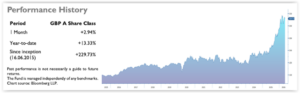
Both financial signals and financial signalling are all wrong. When monetary policy rates and supposedly market-led interest rates are as low as they currently are it is not a sign of confidence, but rather a reflection of absolute terror on the part of the crippled institutions that have been buying them in preference to any form of more constructive lending or investment. It is a moot point as to whether the next financial crisis is now upon us, in the form of imminent financial failures by US and / or euro zone banks and perhaps German or Italian insurers and pension funds. We would argue, rather, that the last financial crisis never got resolved in the first place. The answer, we conclude, is now to avoid paper promises by bankrupt states and institutions entirely, and to seek value in sensibly priced real assets, notably highly cash-generative but lightly indebted commodity-related companies. That is how we are largely positioned and the historic returns of our one (multi-asset, absolute return-focused) fund, the VT Price Value Portfolio, are shown below:
Keir Starmer didn’t receive a highly articulate mauling from a rival during his ‘reset’ speech last week. He inflicted the damage on himself. Rather than succumb to the verbal savagery of others, he effectively announced his functional departure all by himself, using his own awkward stylings. His battle is now nearly over. As investors, ours has just begun. But in the battle for capital survival against the malign forces of our own government, we believe we have the right approach, and the right tools, to win the fight.
………….
As you may know, we also manage bespoke investment portfolios for private clients internationally. We would be delighted to help you too. Because of the current heightened market volatility we are offering a completely free financial review, with no strings attached, to see if our value-oriented approach might benefit your portfolio – with no obligation at all:
Get your Free
financial review
…………
Tim Price is co-manager of the VT Price Value Portfolio and author of ‘Investing through the Looking Glass: a rational guide to irrational financial markets’. You can access a full archive of these weekly investment commentaries here. You can listen to our regular ‘State of the Markets’ podcasts, with Paul Rodriguez of ThinkTrading.com, here. Email us: info@pricevaluepartners.com.
Price Value Partners manage investment portfolios for private clients. We also manage the VT Price Value Portfolio, an unconstrained global fund investing in Benjamin Graham-style value stocks and real assets, and also in systematic trend-following funds.
Take a closer look
Take a look at the data of our investments and see what makes us different.
LOOK CLOSERSubscribe
Sign up for the latest news on investments and market insights.
KEEP IN TOUCHContact us
In order to find out more about PVP please get in touch with our team.
CONTACT USTim Price