“Sir, John Authers, in ‘Loser’s Game’ (The Big Read, December 22), could have delved deeply into the flaws in the asset management business as it has evolved in recent decades, rather than accepting the industry’s own terms or focusing on tweaks to “active” management that might improve results..
“Mr Authers could also have challenged the bureaucratic thinking and methods asset management has adopted in the course of chasing its “bogeys”, starting with the Big Ideas.. Then there are the model portfolios, relative-weightings, “style drift”, investment committees, the requirement to be fully invested and so on — all bog down decision-making and most have nothing to do with genuine investing. In adopting these practices the fund management business has created a recipe for mediocrity.
“In investing, it is never a good idea to do what everyone else is doing. Piling into passive index funds during a year of decidedly poor relative results for active managers, and especially after a long period of rising security prices is likely to lead to future disappointment, just as it did in 1999. This leads us to another line of inquiry for Mr Authers: even assuming “beating” an index is worthwhile, why must we do it all of the time ? It is a paradox of investment that in order to do well in the long run, you sometimes have to do “poorly” in the short run. You have to accept the fact that often you will not “beat” an index; sometimes you don’t even want to — think of the Nasdaq in 1999, for example..”
– Letter to the FT from Mr. Dennis Butler, December 30, 2014.
“We live in a time of great uncertainty and confusion. Events keep happening that seem inexplicable and out of control. Donald Trump, Brexit, the War in Syria, the endless migrant crisis, random bomb attacks.. And those who are supposed to be in power are paralysed – they have no idea what to do. This film is the epic story of how we got to this strange place. It explains not only why these chaotic events are happening – but also why we, and our politicians, cannot understand them.”
- Introduction to the documentary ‘HyperNormalisation’ by Adam Curtis (2016).
Get your Free
financial review
Ever heard of Vladislav Surkov ? Surkov is a businessman and politician who has served as one of President Putin’s more influential advisors, someone from the avant-garde art world who has taken ideas from the world of conceptual art and put them to work at the heart of modern politics.
Surkov has apparently sponsored all kinds of special interest groups, including neo-Nazi skinheads, liberal human rights activists, and even parties opposed to Putin himself. But his masterstroke was to let it be known exactly what he was doing. From that moment on, nobody could be sure any more what was real, and what was fake. In the words of one journalist, “It is a strategy of power that keeps any opposition constantly confused.”
Here’s an example.
Just as war broke out in Ukraine, Surkov published a short story about what he called ‘non-linear war’. The underlying aim, says Surkov, is not to win the war per se, but to use it to create a constant state of “destabilised perception”, so that people can be managed, and controlled. This is the essence of George Orwell’s ‘1984’.
Looking at the world we live in, we must ask, is something similar happening here ?
The British army has been told to stop “non-essential” training exercises to save money, even as we are told to prepare for war with Russia. Meanwhile, the British government is spending £655 million on improving infrastructure – in Angola.
Our chancellor proudly declares that the economy is growing – but for most people, their standard of living and wages in real terms are going down, as inflation tracks inexorably higher. Adam Curtis in his documentary alludes to
“..the strange mood of our time, where nothing really makes any coherent sense. We live with a constant vaudeville of contradictory stories that makes it impossible for any real opposition to emerge, because they can’t counter it with any coherent narrative of their own.”
This gives rise to an important question for all of us as we attempt to steer our own portfolios through the vicissitudes of politics and the financial markets – and the news cycle. Which news sources do we trust, and which should we trust ?
In our view, the only certainty is price and as we’ll see later, even that is no longer trustworthy.
Let’s start by looking at the problem.
Who can we trust?
Historians divide the world of historical material into two camps: primary and secondary sources.
Primary sources are the raw data – the Gettysburg Address, the Magna Carta, Hansard.
Secondary sources are the commentary and analysis and interpretation that spring up to help make sense of it all. A good example of the latter is Barbara Tuchman’s magisterial account of the events leading up to the First World War, ‘The Guns of August’.
But only one of these types of source can be objective – the primary source. It is unequivocal. We know it happened. We know precisely what language was used.
The secondary source may well have value too, but it is by definition subjective. It is an individual person’s subjective analysis of an objective event. It is subject to bias, whim and caprice. Not to mention being misremembered.
Traditionally in financial markets, the equivalent of the primary source is the price: the price at which a given instrument was exchanged between a buyer and a seller. If this instrument was traded on a public exchange, there is a public record of what that price was.
Price alone doesn’t tell us whether gold, for example, is a buy at around $4300 (though we happen to think it is), but we do know what its range has been since 2000 (a low of roughly $250 an ounce in 2001 to a high of around $5600 back in January 2026) – so we can see it in context.
The price history is the one and only objective thing we can know about a financial instrument. It’s a fact. Everything else will be a subjective opinion subject to inevitable human bias.
The problem we all have is that years of Quantitative Easing and a host of other forms of financial repression and central bank intervention have destroyed the price mechanism. We no longer can be sure which prices to trust. Bond markets have been most directly affected by the printing of money, by QE purchases and by the artificial suppression of interest rates, and latterly by the belated return of the bond market vigilantes, but we also know that central banks have been explicitly buying listed stocks and currencies as well. Gold is the outlier here, in that it’s probably the only financial asset that central banks want to see lower in price (because a high gold price points out to the world that they have lost control of inflation and lost control of the markets).
So how are investors expected to survive in these unfamiliar territories ?
Picking up dollar bills for fifty cents
Our interest in ‘value’ investments is in part a direct response to this policy of price manipulation. If you’re concerned about the level of market prices, it makes sense to concentrate on investments that appear to have been least affected by monetary stimulus. The shorthand way of summarising ‘value’ investing is: seeking out dollar bills that can be bought for fifty cents. The longhand way isn’t that much longer:
- Don’t buy rubbish
- Don’t overpay for the good stuff.
Walter Schloss, a disciple of Ben Graham, wrote the following superb advice which constitutes another great introduction to the essential principles of value investing:
- Price is the most important factor to use in relation to value.
- Try to establish the value of the company. Remember that a share of stock represents a part of a business and is not just a piece of paper.
- Use book value as a starting point to try and establish the value of the enterprise. Be sure that debt does not equal 100% of the equity.
- Have patience. Stocks don’t go up immediately.
- Don’t buy on tips or for a quick move. Let the professionals do that, if they can. Don’t sell on bad news.
- Don’t be afraid to be a loner but be sure that you are correct in your judgment. You can’t be 100% certain but try to look for weaknesses in your thinking.
- Have the courage of your convictions once you have made a decision.
- Have a philosophy of investment and try to follow it.
- Don’t be in too much of a hurry to sell. Be aware of the level of the stock market. Are yields low and P/E ratios high? Are people very optimistic?
- When buying a stock, I find it very helpful to buy near the low of the past few years.
- Try to buy assets at a discount than to buy earnings. Earnings can change dramatically in a short time. Usually assets change slowly. One has to know much more about a company if one buys earnings.
- Listen to suggestions from people you respect. This doesn’t mean you have to accept them. Remember it’s your money and generally it’s harder to keep money than to make it. Once you lose a lot of money it is hard to make it back.
- Try not to let your emotions affect your judgment. Fear and greed are probably the worst emotions to have in connection with the purchase and sale of stocks.
- Remember compounding. For example, if you can make 12% a year and reinvest the money back, you will double your money in 6 years.
- Prefer stocks over bonds. Bonds will limit your gains and inflation will reduce your purchasing power.
- Be careful of leverage. It can go against you.
All of which is just as relevant today as when Schloss first penned this note.
We maintain a portfolio approach that attempts to cover all the bases, so to speak. We hold cash opportunistically (but we currently hold no bonds). We invest in systematic trend-following funds opportunistically. We hold bullion. We hold sensibly priced commodity businesses and other real assets and value stocks.
The beauty of a multi-asset approach is that if the instruments are selected carefully enough, they can hedge against any number of unforecastable and unforeseeable outcomes. We may not be able to see the future, but we can prepare for it. If we had to sum up our approach to investing it would be: “Diversify. Distrust governments. And buy cheaply.”
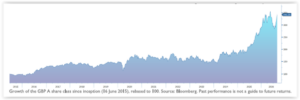
We manage just one unitised fund, the VT Price Value Portfolio (in addition to bespoke discretionary portfolios). Its returns since inception are shown below.
………….
As you may know, we also manage bespoke investment portfolios for private clients internationally. We would be delighted to help you too. Because of the current heightened market volatility we are offering a completely free financial review, with no strings attached, to see if our value-oriented approach might benefit your portfolio – with no obligation at all:
Get your Free
financial review
…………
Tim Price is co-manager of the VT Price Value Portfolio and author of ‘Investing through the Looking Glass: a rational guide to irrational financial markets’. You can access a full archive of these weekly investment commentaries here. You can listen to our regular ‘State of the Markets’ podcasts, with Paul Rodriguez of ThinkTrading.com, here. Email us: info@pricevaluepartners.com.
Price Value Partners manage investment portfolios for private clients. We also manage the VT Price Value Portfolio, an unconstrained global fund investing in Benjamin Graham-style value stocks and real assets, and also in systematic trend-following funds. The fund was “Highly commended” in Investment Week’s 2026 Fund Manager of the Year Awards.

“Sir, John Authers, in ‘Loser’s Game’ (The Big Read, December 22), could have delved deeply into the flaws in the asset management business as it has evolved in recent decades, rather than accepting the industry’s own terms or focusing on tweaks to “active” management that might improve results..
“Mr Authers could also have challenged the bureaucratic thinking and methods asset management has adopted in the course of chasing its “bogeys”, starting with the Big Ideas.. Then there are the model portfolios, relative-weightings, “style drift”, investment committees, the requirement to be fully invested and so on — all bog down decision-making and most have nothing to do with genuine investing. In adopting these practices the fund management business has created a recipe for mediocrity.
“In investing, it is never a good idea to do what everyone else is doing. Piling into passive index funds during a year of decidedly poor relative results for active managers, and especially after a long period of rising security prices is likely to lead to future disappointment, just as it did in 1999. This leads us to another line of inquiry for Mr Authers: even assuming “beating” an index is worthwhile, why must we do it all of the time ? It is a paradox of investment that in order to do well in the long run, you sometimes have to do “poorly” in the short run. You have to accept the fact that often you will not “beat” an index; sometimes you don’t even want to — think of the Nasdaq in 1999, for example..”
– Letter to the FT from Mr. Dennis Butler, December 30, 2014.
“We live in a time of great uncertainty and confusion. Events keep happening that seem inexplicable and out of control. Donald Trump, Brexit, the War in Syria, the endless migrant crisis, random bomb attacks.. And those who are supposed to be in power are paralysed – they have no idea what to do. This film is the epic story of how we got to this strange place. It explains not only why these chaotic events are happening – but also why we, and our politicians, cannot understand them.”
Get your Free
financial review
Ever heard of Vladislav Surkov ? Surkov is a businessman and politician who has served as one of President Putin’s more influential advisors, someone from the avant-garde art world who has taken ideas from the world of conceptual art and put them to work at the heart of modern politics.
Surkov has apparently sponsored all kinds of special interest groups, including neo-Nazi skinheads, liberal human rights activists, and even parties opposed to Putin himself. But his masterstroke was to let it be known exactly what he was doing. From that moment on, nobody could be sure any more what was real, and what was fake. In the words of one journalist, “It is a strategy of power that keeps any opposition constantly confused.”
Here’s an example.
Just as war broke out in Ukraine, Surkov published a short story about what he called ‘non-linear war’. The underlying aim, says Surkov, is not to win the war per se, but to use it to create a constant state of “destabilised perception”, so that people can be managed, and controlled. This is the essence of George Orwell’s ‘1984’.
Looking at the world we live in, we must ask, is something similar happening here ?
The British army has been told to stop “non-essential” training exercises to save money, even as we are told to prepare for war with Russia. Meanwhile, the British government is spending £655 million on improving infrastructure – in Angola.
Our chancellor proudly declares that the economy is growing – but for most people, their standard of living and wages in real terms are going down, as inflation tracks inexorably higher. Adam Curtis in his documentary alludes to
“..the strange mood of our time, where nothing really makes any coherent sense. We live with a constant vaudeville of contradictory stories that makes it impossible for any real opposition to emerge, because they can’t counter it with any coherent narrative of their own.”
This gives rise to an important question for all of us as we attempt to steer our own portfolios through the vicissitudes of politics and the financial markets – and the news cycle. Which news sources do we trust, and which should we trust ?
In our view, the only certainty is price and as we’ll see later, even that is no longer trustworthy.
Let’s start by looking at the problem.
Who can we trust?
Historians divide the world of historical material into two camps: primary and secondary sources.
Primary sources are the raw data – the Gettysburg Address, the Magna Carta, Hansard.
Secondary sources are the commentary and analysis and interpretation that spring up to help make sense of it all. A good example of the latter is Barbara Tuchman’s magisterial account of the events leading up to the First World War, ‘The Guns of August’.
But only one of these types of source can be objective – the primary source. It is unequivocal. We know it happened. We know precisely what language was used.
The secondary source may well have value too, but it is by definition subjective. It is an individual person’s subjective analysis of an objective event. It is subject to bias, whim and caprice. Not to mention being misremembered.
Traditionally in financial markets, the equivalent of the primary source is the price: the price at which a given instrument was exchanged between a buyer and a seller. If this instrument was traded on a public exchange, there is a public record of what that price was.
Price alone doesn’t tell us whether gold, for example, is a buy at around $4300 (though we happen to think it is), but we do know what its range has been since 2000 (a low of roughly $250 an ounce in 2001 to a high of around $5600 back in January 2026) – so we can see it in context.
The price history is the one and only objective thing we can know about a financial instrument. It’s a fact. Everything else will be a subjective opinion subject to inevitable human bias.
The problem we all have is that years of Quantitative Easing and a host of other forms of financial repression and central bank intervention have destroyed the price mechanism. We no longer can be sure which prices to trust. Bond markets have been most directly affected by the printing of money, by QE purchases and by the artificial suppression of interest rates, and latterly by the belated return of the bond market vigilantes, but we also know that central banks have been explicitly buying listed stocks and currencies as well. Gold is the outlier here, in that it’s probably the only financial asset that central banks want to see lower in price (because a high gold price points out to the world that they have lost control of inflation and lost control of the markets).
So how are investors expected to survive in these unfamiliar territories ?
Picking up dollar bills for fifty cents
Our interest in ‘value’ investments is in part a direct response to this policy of price manipulation. If you’re concerned about the level of market prices, it makes sense to concentrate on investments that appear to have been least affected by monetary stimulus. The shorthand way of summarising ‘value’ investing is: seeking out dollar bills that can be bought for fifty cents. The longhand way isn’t that much longer:
Walter Schloss, a disciple of Ben Graham, wrote the following superb advice which constitutes another great introduction to the essential principles of value investing:
All of which is just as relevant today as when Schloss first penned this note.
We maintain a portfolio approach that attempts to cover all the bases, so to speak. We hold cash opportunistically (but we currently hold no bonds). We invest in systematic trend-following funds opportunistically. We hold bullion. We hold sensibly priced commodity businesses and other real assets and value stocks.
The beauty of a multi-asset approach is that if the instruments are selected carefully enough, they can hedge against any number of unforecastable and unforeseeable outcomes. We may not be able to see the future, but we can prepare for it. If we had to sum up our approach to investing it would be: “Diversify. Distrust governments. And buy cheaply.”
We manage just one unitised fund, the VT Price Value Portfolio (in addition to bespoke discretionary portfolios). Its returns since inception are shown below.
………….
As you may know, we also manage bespoke investment portfolios for private clients internationally. We would be delighted to help you too. Because of the current heightened market volatility we are offering a completely free financial review, with no strings attached, to see if our value-oriented approach might benefit your portfolio – with no obligation at all:
Get your Free
financial review
…………
Tim Price is co-manager of the VT Price Value Portfolio and author of ‘Investing through the Looking Glass: a rational guide to irrational financial markets’. You can access a full archive of these weekly investment commentaries here. You can listen to our regular ‘State of the Markets’ podcasts, with Paul Rodriguez of ThinkTrading.com, here. Email us: info@pricevaluepartners.com.
Price Value Partners manage investment portfolios for private clients. We also manage the VT Price Value Portfolio, an unconstrained global fund investing in Benjamin Graham-style value stocks and real assets, and also in systematic trend-following funds. The fund was “Highly commended” in Investment Week’s 2026 Fund Manager of the Year Awards.
Take a closer look
Take a look at the data of our investments and see what makes us different.
LOOK CLOSERSubscribe
Sign up for the latest news on investments and market insights.
KEEP IN TOUCHContact us
In order to find out more about PVP please get in touch with our team.
CONTACT USTim Price